
In This Article
Somewhere around week nine, your skin starts sending mixed signals. One cheek breaks out like you’re sixteen again. The other feels papery and tight. Your favorite retinol — the one that finally got your texture under control — is suddenly on a list of things you’re not supposed to touch. It’s disorienting, and the advice online ranges from “throw out everything” to “don’t worry about it,” neither of which is actually true.
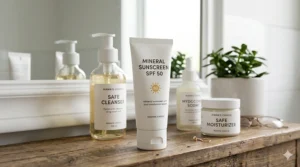
Here’s the more useful version: pregnancy doesn’t require a skincare exile. It requires a smaller, smarter list. A handful of ingredients carry real, documented risk — mostly vitamin-A derivatives and a few hormone-disrupting preservatives — and everything else is mostly fine, sometimes even better suited to the dry, reactive, sun-sensitive skin pregnancy tends to produce. A safe skincare routine during pregnancy is really just your normal routine with the dangerous 5% swapped out.
This guide walks through what to avoid and why, then gets specific: seven real products currently sold on Amazon, organized by what they actually do, with honest pros and cons. As always, treat this as a starting point for a conversation with your OB-GYN or dermatologist, not a replacement for one — pregnancy skin can behave unpredictably, and your provider knows your specific history.
What’s Actually Off-Limits (and Why)?
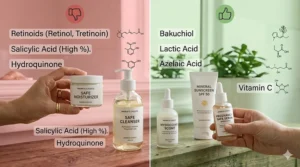
The ingredient-safety conversation gets muddled fast because the internet loves a panic list. The real list, per the American College of Obstetricians and Gynecologists and the American Academy of Dermatology, is shorter and more specific than most blog posts make it sound.
Retinoids are the big one. Oral isotretinoin (Accutane) is unambiguously dangerous in pregnancy — it’s linked to serious birth defects, which is why it requires enrollment in the FDA’s iPLEDGE program before anyone can fill the prescription. Topical retinoids (Retin-A, Differin, Tazorac, and plain retinol) carry a much lower absorption rate, but the data isn’t reassuring enough for ACOG or the AAD to call them safe, so the standard advice is to pause them until after delivery.
Hydroquinone, the skin-lightening ingredient in a lot of dark-spot correctors, gets flagged for a different reason — it absorbs into skin at a notably high rate, and the March of Dimes lists it among ingredients to avoid due to potential developmental concerns.
High-dose salicylic acid (above roughly 2%, and especially in oral or chemical-peel form) is a caution-zone ingredient rather than an outright ban — the kind of thing the AAD says to discuss with a dermatologist rather than use freely. Standard OTC concentrations in cleansers and spot treatments are generally considered low-risk, but prescription-strength peels are a different story.
Then there’s the quieter category: parabens, phthalates, and certain chemical sunscreen filters (oxybenzone, avobenzone, octinoxate), which show up on precautionary-avoidance lists because of endocrine-disruption concerns rather than confirmed harm. You don’t need to interrogate every label, but when a product gives you a choice — mineral sunscreen versus chemical, fragrance-free versus heavily perfumed — pregnancy is a reasonable time to take the more cautious option.
Quick Comparison: The 7 Picks
| Product | Category | Price Range | Key Active | Best For |
|---|---|---|---|---|
| CeraVe Hydrating Facial Cleanser | Cleanser | $9–$13 | Ceramides + HA | Dry, sensitive, reactive skin |
| EltaMD UV Clear SPF 46 | Sunscreen | $39–$45 | Zinc oxide + niacinamide | Acne-prone, melasma-prone skin |
| Mad Hippie Vitamin C Serum | Antioxidant serum | $24–$30 | Sodium Ascorbyl Phosphate | Dullness, mild discoloration |
| Herbivore Bakuchiol Dual-Retinol Alternative Serum | Retinol alternative | $48–$58 | Bakuchiol | Fine lines, texture, retinol swap |
| The Ordinary Azelaic Acid Suspension 10% | Treatment | $10–$15 | Azelaic acid | Pregnancy acne, rosacea, melasma |
| Palmer’s Cocoa Butter Massage Lotion | Body lotion | $7–$12 | Cocoa butter + collagen/elastin | Budget full-body stretch mark prevention |
| Earth Mama Belly Butter | Body butter | $20–$26 | Shea butter + aloe | Itchy skin, fragrance sensitivity |
A quick read on the table: the face routine here runs cheap-to-mid ($9 cleanser, $10–$30 actives) with one splurge in the bakuchiol serum, while the body-care picks split along a predictable line — Palmer’s wins on price-per-ounce and sheer availability, Earth Mama wins on scent tolerance for anyone whose nose has turned against them this trimester. Nobody needs all seven at once; this is a menu, not a checklist.
💬 Just one click — help others make better buying decisions too!😊
✨ Don’t Miss These Exclusive Deals!
🔍 Take your pregnancy skincare routine to the next level with these dermatologist-vetted picks. Click any highlighted product to check current pricing and availability — small swaps now can save you a lot of second-guessing later.
The 7 Picks, One at a Time
1. CeraVe Hydrating Facial Cleanser
This is the cleanser dermatologists default to when someone’s skin barrier is compromised, and pregnancy compromises a lot of skin barriers — hormonal fluctuations pull moisture out of skin faster than usual, which is why the “pregnancy glow” sometimes shows up as flaking instead. CeraVe’s formula leans on three ceramides plus hyaluronic acid rather than foaming surfactants, so it lifts dirt and makeup without the tight, stripped feeling that can make an already-dry face feel worse by lunchtime.
What it’s missing matters as much as what it has: no retinoids, no salicylic acid, no hydroquinone. The one ingredient that occasionally gets side-eye from extra-cautious sources is phenoxyethanol, a preservative capped at 1% by FDA cosmetic guidelines — mainstream OB and dermatology guidance doesn’t flag it as a concern at that level, though if you’re the type who wants zero gray areas, fragrance-free, preservative-light alternatives exist.
✅ Gentle enough for twice-daily use, won’t disrupt other actives, broadly available
❌ Not exfoliating (you’ll want a separate product for texture), the 16 oz size disappears fast if you’re using it as a body wash too
In the $9–$13 range for the full-size bottle, it’s hard to find a more boring-in-a-good-way recommendation.
2. EltaMD UV Clear Broad-Spectrum SPF 46
Sunscreen is non-negotiable during pregnancy — melasma (“the mask of pregnancy”) is driven partly by hormones and partly by sun exposure, so skipping SPF doesn’t just risk a burn, it actively feeds the discoloration half of pregnant skin’s two favorite problems. The complication is that several common chemical filters (oxybenzone, avobenzone) are the ones on the more-cautious avoidance lists, which pushes most dermatologists toward mineral formulas.
EltaMD’s UV Clear uses zinc oxide as its active filter, paired with niacinamide, which does double duty calming redness while the zinc handles UV protection. It was originally formulated for rosacea and post-procedure skin, which is why it sits so well under makeup without the chalky cast a lot of mineral sunscreens leave on darker or even just well-moisturized skin.
✅ No white cast despite being mineral, doubles as a light moisturizer, fits acne-prone skin
❌ Pricier than drugstore mineral options, the 1.7 oz bottle is small for daily face-and-neck use
Expect to pay somewhere in the high $30s to mid $40s — steep for sunscreen, but it’s the bottle people actually finish instead of abandoning halfway through the tube.
3. Mad Hippie Vitamin C Serum
Vitamin C is the ingredient dermatologists hand pregnant patients as the retinol consolation prize, and it’s a reasonable trade rather than a downgrade — it stimulates collagen through an antioxidant pathway instead of a retinoid pathway, with brightening as a side benefit. The catch with vitamin C generally is that pure L-ascorbic acid oxidizes fast and can sting.
Mad Hippie sidesteps that by using sodium ascorbyl phosphate, a more stable, lower-irritation form of vitamin C, layered with vitamin E and ferulic acid for an antioxidant trio that’s more resistant to breaking down in the bottle. It’s formulated for sensitive and acne-prone skin specifically, which matters if pregnancy hormones have you breaking out for the first time since high school.
✅ Low irritation potential, brightens without retinoid risk, plays well with sunscreen
❌ Gentler form of vitamin C means slower, more gradual results than potent L-ascorbic acid formulas; bottle is small at 1.02 oz
Price typically lands in the mid-$20s to $30 range, and it’s one of the few actives on this list you can layer under sunscreen every single morning without a second thought.
4. Herbivore Bakuchiol Dual-Retinol Alternative Serum
Bakuchiol gets called “nature’s retinol,” which oversells it slightly but isn’t wrong about the mechanism — a 2018 study comparing the two found bakuchiol produced comparable improvements in fine lines and discoloration over 12 weeks, with meaningfully less irritation. Critically, bakuchiol isn’t a vitamin-A derivative, which is the category that actually raises red flags in pregnancy, so it doesn’t carry the same documented concern.
That said, “not a known risk” isn’t the same as “extensively studied in pregnant populations” — bakuchiol is still a newer cosmetic ingredient, and the safety data is reassuring rather than exhaustive. Most dermatologists are comfortable with it during pregnancy, but it’s a reasonable one to mention at your next OB visit rather than assume.
Herbivore’s version pairs 1% bakuchiol with peptides and mastic resin, aimed at firming and smoothing rather than aggressive exfoliation — a gentler lane than some of the higher-percentage bakuchiol-retinol hybrid serums on the market.
✅ Closest legal stand-in for retinol’s texture-smoothing effect, vegan and fragrance-light formula, suitable for sensitive skin
❌ Premium price point, results take longer to show than actual retinol
Sitting around $48–$58, it’s the most expensive item on this list, which tracks — it’s also the one doing the most specialized job.
5. The Ordinary Azelaic Acid Suspension 10%
If you only add one active to your pregnancy routine, dermatologists tend to point here. Azelaic acid is FDA Pregnancy Category B, and the AAD recommends it without the usual hedging reserved for “probably fine” ingredients — only about 4% of what’s applied topically gets absorbed systemically, and it’s a compound your own skin already produces in small amounts via a naturally occurring fungus. For pregnancy acne and pregnancy-triggered rosacea specifically, it’s one of the only genuinely potent options left on the table once retinoids and prescription-strength salicylic acid are off it.
The formula itself is a thick, silicone-based suspension rather than a thin serum, which is a deliberate choice — azelaic acid penetrates skin poorly at cosmetic concentrations, and the silicone base with a penetration enhancer compensates for that. The trade-off is a texture some people find genuinely annoying: it can pill under moisturizer if you’re not patient about absorption time.
✅ Clinical-grade efficacy for acne, rosacea, and melasma at a drugstore price, one of the few “no asterisks” actives during pregnancy
❌ Pilling is a real and common complaint, requires a specific light-touch application technique
At $10–$15 for a 1 oz bottle, it’s also the best value on this entire list relative to what it actually does.
6. Palmer’s Cocoa Butter Formula Massage Lotion for Stretch Marks
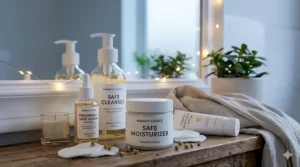
Stretch marks are mostly a function of genetics and how fast skin stretches, not a moral failing solvable by the right lotion — even Consumer Reports’ product comparisons note that cocoa butter performs no better than a placebo in controlled studies. So why is this the cream nearly every pregnant person has heard of? Because the value isn’t stretch-mark prevention, it’s the simple, unglamorous job of keeping skin hydrated and less itchy as it stretches, which it does reliably and cheaply.
Palmer’s formula blends cocoa and shea butters with collagen, elastin, and a handful of oils, and it’s thick enough that a little covers a lot of belly. The fragrance is the most divisive thing about it — it smells distinctly like chocolate, which some testers love and others, mid-first-trimester-nausea, cannot tolerate at all.
✅ Cheapest effective option on this list, large bottle lasts the full pregnancy, widely available everywhere
❌ Strong cocoa scent is a dealbreaker for nausea-prone users, doesn’t actually prevent stretch marks despite the marketing angle
At roughly $7–$12 for a full-size bottle, it’s the lotion people buy without thinking twice, and that’s basically the point.
7. Earth Mama Belly Butter
This is the answer for everyone who bounced off Palmer’s because of the smell. Earth Mama built this specifically around morning-sickness-safe fragrance — light, citrus-forward, easy to tolerate even when your sense of smell has turned against you — and backed it with a genuinely clean ingredient list: no petroleum, no artificial preservatives, no synthetic fragrance, third-party certified through Oregon Tilth and Leaping Bunny.
The texture sits between a lotion and a true butter: rich enough to address the itchy, tight feeling of stretching skin, but it absorbs faster than a straight shea or cocoa butter would. It’s also one of the few products on this list explicitly marketed and reviewed by pregnant users specifically for the itch-relief angle rather than the stretch-mark-prevention angle, which is the more achievable promise anyway.
✅ Mild, nausea-friendly scent, genuinely clean formulation, absorbs faster than thicker butters
❌ Triple the price of Palmer’s for a comparable volume, scent still isn’t universally loved (a small number of reviewers report an off note in some batches)
Expect to pay $20–$26 for an 8 oz bottle — a real premium over the drugstore option, but for anyone with a sensitive nose this trimester, it’s often worth it.
Building the Routine, Not Just the Shopping List
Buying seven products doesn’t help much if you’re not sure what order they go in or which ones to skip on a given day. Here’s the practical version:
Morning: Cleanse → vitamin C serum → moisturizer → mineral sunscreen. The vitamin C and sunscreen are doing complementary antioxidant-and-barrier work, and applying sunscreen last (over moisturizer, under makeup if you wear it) is what actually gives you the SPF number printed on the bottle.
Evening: Cleanse → bakuchiol serum or azelaic acid (not both in the same session if your skin is reactive — alternate nights) → moisturizer. Bakuchiol and azelaic acid can technically be layered, but introducing two actives at once during a period when your skin is already more reactive than usual is asking for irritation you can’t easily troubleshoot.
Body, daily: Stretch-mark lotion or butter, applied to belly, hips, and chest while skin is slightly damp post-shower — it traps moisture more effectively than applying to bone-dry skin.
A few mistakes show up constantly in pregnancy skincare routines. The first is panic-purging an entire routine the moment a positive test shows up, including perfectly fine products like vitamin C and niacinamide that never needed to go. The second is assuming “natural” or “clean” labeling means pregnancy-safe by default — plenty of essential-oil-heavy “natural” products carry their own caution flags. The third is skipping sunscreen because of melasma worry over chemical filters, when the actual fix is switching to mineral, not skipping SPF altogether.
Common Mistakes When Choosing Pregnancy Skincare
A few patterns are worth flagging on their own, because they’re easy to fall into without realizing it.
Treating “fragrance-free” and “unscented” as the same thing. Unscented products often contain masking fragrance to cancel out the smell of other ingredients — fragrance-free means no fragrance compounds at all. If scent sensitivity is driving your nausea, check for the specific term.
Assuming a higher price means a safer formula. Price tracks brand positioning and packaging far more than it tracks pregnancy safety. The Ordinary’s $12 azelaic acid suspension has a cleaner pregnancy-safety profile than plenty of $80 serums that quietly include retinyl palmitate.
Forgetting that “pregnancy safe” isn’t a regulated label. No government body certifies products as pregnancy-safe — it’s a marketing phrase brands apply themselves, sometimes loosely. The ingredient list is the actual source of truth, not the sticker on the bottle.
What to Expect: Real-World Skin Changes by Trimester
First-trimester skin tends to swing toward oilier and more breakout-prone as hormone levels spike — this is where azelaic acid earns its keep. Second trimester often brings the so-called glow, which is partly increased blood flow and partly just better hydration if your routine has caught up. It’s also when melasma tends to show up if it’s going to, making sunscreen consistency matter most. Third trimester is when stretching accelerates fastest, and itchy, tight skin on the belly and chest becomes the dominant complaint — heavier moisturizers and body butters do more there than any face product will.
FAQ
❓ What is a safe skincare routine during pregnancy?
❓ Is vitamin C serum safe to use while pregnant?
❓ Can I use sunscreen with SPF while pregnant?
❓ Does cocoa butter actually prevent stretch marks?
❓ Is azelaic acid safe for pregnancy acne?
Conclusion
The honest version of pregnancy skincare is less dramatic than the internet makes it sound. You’re not rebuilding your routine from scratch — you’re swapping out a handful of higher-risk ingredients and leaning a little harder on the things that were already good for sensitive, reactive skin: gentle cleansers, mineral sunscreen, antioxidants, and a heavier hand with moisturizer than you’re maybe used to. The seven products above cover the actual gaps — retinol, sunscreen, acne, and stretching skin — without asking you to overhaul anything that wasn’t broken.
If you take one thing from this list, make it the sunscreen. Melasma is stubborn and a lot easier to prevent than to fade afterward, and a $40 mineral formula is cheap insurance against months of trying to undo it postpartum.
✨ Found a product here worth trying?
Check current availability before your next skincare restock — formulas and stock can shift, so it’s worth confirming what’s in the bottle before you buy.
Recommended for You
- Exosome Serum Worth the Price? 7 Best Picks Tested & Ranked (2026)
- Best Exosome Serum Anti-Aging: 7 Proven Picks for 2026
- 7 Best Tallow Moisturizer Acne Prone Skin in 2026
Disclaimer: This article contains affiliate links. As an Amazon Associate, I earn from qualifying purchases. If you purchase products through these links, we may earn a small commission at no additional cost to you. This article is for general informational purposes and is not a substitute for medical advice — talk to your OB-GYN or dermatologist before changing your skincare routine during pregnancy.
✨ Found this helpful? Share it with your friends! 💬🤗
