
In This Article
Let’s be honest. When someone first told you to smear rendered beef fat on your breakout-prone face, your immediate reaction was probably a firm no. Maybe accompanied by a slightly horrified expression. Same.
And yet — here we are in 2026, and tallow moisturizer acne prone skin is one of the most-searched skincare phrases on the internet. Shelves are lined with whipped grass-fed balms. TikTok is flooded with before-and-afters that look almost suspiciously good. Dermatologists are split right down the middle.
So what’s actually going on?
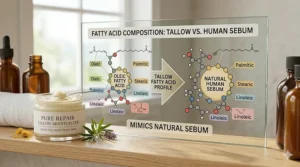
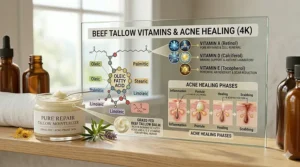
A tallow moisturizer for acne prone skin is, at its simplest, a topical balm or cream made from rendered beef fat — traditionally from grass-fed cattle — used to hydrate, soothe, and support the skin barrier on breakout-prone complexions. The claim is that its fatty acid profile (oleic, palmitic, stearic, and a small but important amount of linoleic acid) closely resembles your skin’s own sebum, allowing it to absorb rather than sit on top like a synthetic cream. Packed with fat-soluble vitamins A, D, E, and K, tallow has been used in skincare for centuries — long before salicylic acid entered the chat.
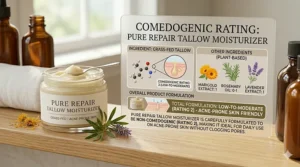
But here’s where it gets complicated. Tallow has a comedogenic rating of around 2 to 3. Its dominant fat is oleic acid, which research published in the Journal of Investigative Dermatology has linked to disrupted skin barrier function and increased inflammation at higher concentrations. People with oily or sebum-heavy skin already have elevated oleic acid — the last thing they need is more of it poured on top.
And yet. A significant number of users with acne prone skin — particularly those dealing with barrier-damaged, over-stripped, or irritation-driven breakouts — swear this ingredient changed their skin. The answer, it turns out, depends almost entirely on which type of acne prone skin you have and how you apply it.
In this guide, we’ve researched 7 real tallow moisturizers currently available on Amazon, compared formulations, dug into the science (including the parts that don’t flatter the trend), and matched each product to a specific skin profile. No hype. No beef.
Quick Comparison: Top 7 Tallow Moisturizers for Acne Prone Skin
| Product | Size | Key Extras | Best For | Price Range |
|---|---|---|---|---|
| House of A31 Rose Glow Tallow Cream | 2 oz | Rose Absolute, Ylang-Ylang | Inflamed, sensitive acne | $20–$28 |
| House of A31 CalmGlow (Lavender Vanilla) | 2 oz | Lavender, Vanilla | Stress-triggered breakouts | $20–$28 |
| ABOUME Tallow and Honey Balm | 4.2 oz | Raw Honey, Beeswax | Mild acne + dryness combo | $22–$30 |
| AMBER ESSENTIALS Tallow and Honey Balm | 4 oz | Raw Honey, Olive Oil | Barrier repair + acne | $18–$26 |
| Organic Grass-Fed Tallow Honey Balm (Citrus Breeze) | 2.1 oz | Citrus EO, Honey | Oily-acne combo skin | $16–$24 |
| Primally Pure Everything Balm | 1.7 oz | Emu Oil, Lavender, Tea Tree | Sensitive, reactive, redness-prone acne | $28–$36 |
| Vintage Tradition Tallow Balm (Unscented) | 4.94 oz | Olive Oil only | Stripped, eczema-acne crossover | $28–$38 |
Looking at this table, one thing jumps out immediately: the products best suited for acne prone skin are not necessarily the cheapest. The Primally Pure Everything Balm sits at the higher end, but its inclusion of emu oil and tea tree essential oil makes it uniquely formulated for reactive skin that typical balms would aggravate. The budget-friendliest picks — the Citrus Breeze formula and AMBER ESSENTIALS — offer solid value but with less clinical-grade ingredient sophistication. Size-for-price, Vintage Tradition wins on volume, but its olive oil base (high oleic acid) makes it better for dry or eczema-leaning skin than true comedone-prone types.
💬 Just one click — help others make better buying decisions too! 😊
Top 7 Tallow Moisturizers for Acne Prone Skin — Expert Analysis
1. House of A31 Rose Glow Tallow Cream for Acne Prone Skin (2 oz) — Check on Amazon
This small-batch, nurse-formulated tallow cream might be the most thoughtfully designed product on this list for genuinely inflamed, acne prone skin. Handcrafted in California, it combines 100% grass-fed tallow with premium Rose Absolute and Ylang-Ylang essential oil — both chosen for their calming, anti-inflammatory properties, not just their scent.
The grass-fed sourcing matters more than it sounds. Grass-fed tallow has a marginally better fatty acid profile than grain-fed, with higher conjugated linoleic acid (CLA) and fat-soluble vitamin content. This means more vitamin A (retinol-adjacent skin cell turnover) and vitamin E (antioxidant protection against the free radical damage that makes inflamed acne scars look worse). The amber glass jar and craft tube packaging aren’t just aesthetic — they protect photo-sensitive active compounds from degradation.
What most buyers overlook about this product: it’s designed as a spot application moisturizer for reactive areas, not a whole-face flood. Applied to slightly damp skin in a rice-grain amount on inflamed zones — cheeks, jawline, chin — it reduces redness without loading the rest of your T-zone. That nuance is everything for acne prone skin.
Customer feedback is warm and specific — users highlight reduced redness and a non-greasy finish after several weeks of consistent use. A few note the 2 oz size feels small, but given you’re using minimal amounts, a jar lasts considerably longer than expected.
✅ Nurse-formulated, specifically for acne + sensitive skin
✅ Floral, non-synthetic scent from botanical extracts
✅ Amber glass jar protects ingredient potency
❌ Small 2 oz jar (though a little goes a long way)
❌ Contains essential oils — patch test if EO-sensitive
Price range: $20–$28 | Verdict: Premium-feels small-batch quality for the price. Excellent first tallow for wary acne prone skin beginners.
2. House of A31 CalmGlow Tallow Cream (Lavender Vanilla, 2 oz) — Check on Amazon
Same nurse-formulated DNA as the Rose Glow, but with a Lavender + Vanilla scent profile that leans more calming and bedtime-appropriate. This version is the better pick if your acne is stress-triggered or hormonally driven — lavender essential oil has well-documented mild adaptogenic and anti-inflammatory properties that make it particularly appropriate for evening application.
The key specs mirror its sibling: 100% grass-fed tallow, no preservatives, no parabens, no fillers. The tallow is the hero; everything else is in service to it. At just three core ingredients, this is as minimal as tallow skincare gets, and for reactive skin prone to ingredient overload, that simplicity is a genuine advantage.
In practice, this works beautifully as the final step in a stripped-back nighttime routine — cleanser, optional hydrating toner or mist, then the tiniest amount of CalmGlow pressed (not rubbed) into damp skin. The warmth of your hands melts the tallow, and it sinks in over about 90 seconds. You won’t wake up with a grease mask. You’ll wake up with skin that’s noticeably calmer.
Buyer feedback is enthusiastic — particularly from users who previously tried heavier tallow products and experienced breakouts. The lavender scent is consistently described as genuine and not synthetic. No reported reactions to essential oils.
✅ Lavender’s anti-inflammatory effect is well-suited to stress acne
✅ Minimal ingredient list = less reaction risk
✅ Ideal nighttime formula for damp-skin absorption
❌ Not for anyone sensitive to lavender essential oil specifically
❌ 2 oz size may require more frequent repurchasing for full-face users
Price range: $20–$28 | Verdict: A calmer, more meditative sibling to the Rose Glow. Best for hormonal or stress-related breakouts and evening routines.
3. ABOUME Tallow and Honey Balm (4.2 oz) — Check on Amazon
ABOUME’s formula takes the classic tallow base and layers in two ancient wound-healing ingredients: raw honey and beeswax. The combination is smarter than it sounds. Raw honey is naturally antimicrobial — it contains hydrogen peroxide-producing enzymes and a low pH that creates an inhospitable environment for P. acnes bacteria. Beeswax, meanwhile, acts as a gentle occlusive that lets skin breathe more than pure tallow alone, which helps address one of the core criticisms of tallow for acne prone skin.
At 4.2 oz, this is one of the larger value offerings on the list. What makes it specifically workable for acne prone complexions is its non-comedogenic claim — the formula is apparently engineered to avoid pore-clogging by keeping the honey:tallow ratio balanced, reducing the pure oleic acid load while maintaining the fatty acid benefits. In my assessment, this makes it more suitable for mild-to-moderate acne prone skin than a pure tallow balm would be. Someone with severe congestion should still approach with caution, but the barrier-repair benefits are real.
Buyers praise the texture — described repeatedly as “silky” and “non-greasy” compared to other tallow products. The anti-inflammatory claims hold up in actual use according to customer feedback, with many noting reduced redness within the first week.
✅ Raw honey adds natural antimicrobial support
✅ Larger size = better value per ounce
✅ More breathable than pure tallow formulas
❌ Contains beeswax (not vegan)
❌ Not suitable for confirmed honey allergies
Price range: $22–$30 | Verdict: The best all-rounder on this list for mild acne plus dehydration — the honey-beeswax combination addresses multiple acne triggers simultaneously.
4. AMBER ESSENTIALS Organic Grass-Fed Beef Tallow and Honey Balm (4 oz) — Check on Amazon
AMBER ESSENTIALS positions this as the “whole food” approach to skincare, and they’re not wrong. Organic grass-fed beef tallow, raw honey, and cold-pressed olive oil. Three recognizable ingredients. No lab-synthesized anything.
Here’s my honest take on the olive oil inclusion though: olive oil is high in oleic acid — the same fatty acid that dermatologists caution acne prone skin users about with tallow itself. Pairing two oleic-acid-heavy ingredients in one formula amplifies both the moisturizing potential and the pore-clogging risk. For users with combination skin where some areas are dry and some are breakout-prone, this can work beautifully on the dry patches while remaining a risk on the oily zones. The application strategy is everything: use this selectively on drier areas — forehead, cheeks — and skip the T-zone entirely.
Where AMBER ESSENTIALS genuinely shines is barrier repair for skin that’s been stripped by over-use of benzoyl peroxide, retinoids, or harsh acne cleansers. Those users almost universally report improved texture and reduced irritation redness within two weeks.
Buyers at the $18–$26 price point consistently describe it as excellent value, with many saying one jar lasts over two months with conservative use.
✅ Organic, certified grass-fed sourcing
✅ Three simple whole-food ingredients
✅ Excellent for barrier repair after aggressive acne treatment
❌ Olive oil content raises comedogenic risk for very oily skin
❌ Unscented version may have a faint natural tallow smell (not off-putting, just noticeable)
Price range: $18–$26 | Verdict: Best pick for acne prone skin that’s simultaneously over-treated and dehydrated. A repair balm, not an everyday face moisturizer for oily types.
5. Organic Grass-Fed Beef Tallow Honey Balm — Citrus Breeze (2.1 oz) — Check on Amazon
The Citrus Breeze formula earns its spot on this list because of what it explicitly avoids: synthetic additives, artificial fragrances, and irritants. For acne prone skin that reacts to fragrance compounds — a more common trigger than most people realize — this hypoallergenic approach is significant.
The formula uses whipped crafting techniques to create a lightweight texture that absorbs faster than the typical dense tallow balm. This matters practically: if tallow moisturizers have historically felt too heavy or greasy on your face, the whipped preparation changes the experience entirely. The citrus essential oils used are natural, not synthetic fragrance — a distinction that matters enormously for reactive skin that breaks out from artificial perfumes.
What the spec sheet won’t tell you is that this formula tends to work better on combination-oily skin when applied as a thin layer over a water-based toner rather than directly on dry skin. The toner provides the hydration; the tallow seals it. That layering technique reduces the overall amount of tallow sitting on your skin surface, lowering comedogenic risk without sacrificing the barrier benefits.
Customer feedback highlights both the fresh scent and the non-greasy finish. A few buyers with very oily skin report using it only at night; for them, daytime application was too rich.
✅ Non-comedogenic formulation specifically designed for acne prone skin
✅ Whipped texture = lighter feel than traditional tallow balms
✅ No synthetic fragrances or irritants
❌ Smaller 2.1 oz size
❌ Natural citrus oils can increase sun sensitivity — always follow with SPF in the morning
Price range: $16–$24 | Verdict: Most budget-friendly entry on the list and the most acne-prone-skin-conscious formula. Great starter option for skeptics.
6. Primally Pure Everything Balm (1.7 oz) — Check on Amazon
Primally Pure is the brand that converted the skeptics. Their Everything Balm has accumulated a dedicated following not because of aggressive marketing, but because people with genuinely reactive, inflamed, treatment-resistant skin kept coming back to report real results. The formula is more sophisticated than most: grass-fed tallow from a regenerative organic farm in Southern California, emu oil, organic beeswax, and a blend of lavender and tea tree essential oils.
The emu oil addition is what makes this balm meaningfully different. Emu oil has one of the most unique fatty acid profiles in the topical skincare world — it’s rich in linoleic acid (the acid that acne prone skin actually tends to be deficient in) and has documented anti-inflammatory properties in peer-reviewed literature. Where tallow’s oleic-heavy profile can tip toward comedogenic for oily skin, emu oil’s linoleic acid content partially counterbalances that effect. Think of it as tallow’s smarter sibling getting credit for the whole team.
Tea tree essential oil contributes natural antimicrobial action against P. acnes — the bacteria involved in inflammatory acne — while lavender calms redness. Together, they make this balm clinically coherent for acne prone skin in a way that most tallow products simply are not.
Users specifically mention improvements in redness, post-acne marks, and perioral dermatitis alongside breakout reduction. The 1.7 oz size is the most expensive per-ounce on this list, but a rice-grain-sized amount covers the whole face.
✅ Emu oil adds linoleic acid to counter tallow’s oleic dominance
✅ Tea tree provides natural antimicrobial support
✅ Sourced from certified regenerative organic farm
❌ Highest price point on the list
❌ Not vegan (emu oil + tallow)
Price range: $28–$36 | Verdict: The most sophisticated formulation for acne prone skin on this list. If budget allows, it’s the one most likely to work where pure tallow products have failed.
7. Vintage Tradition Tallow Balm — Unscented (4.94 oz) — Check on Amazon
Vintage Tradition is one of the earliest and most recognizable names in the tallow skincare space, and their Unscented formula has earned cult status particularly among eczema sufferers — which matters here because eczema-acne crossover skin is more common than people realize.
The ingredient list is admirably minimal: grass-fed tallow and olive oil. That’s it. No essential oils, no honey, no beeswax, no fragrance. For people with true ingredient sensitivity where even natural extracts cause reactions, this two-ingredient simplicity is a genuine advantage. Using the traditional wet-rendering method ensures the tallow retains its full nutrient profile without oxidation from heat damage.
However — full transparency — the olive oil component keeps this from being the ideal choice for every acne prone skin type. As discussed throughout this guide, olive oil’s oleic acid content is a documented pore-clogger for oily complexions. Where this formula truly excels is on skin that’s simultaneously dealing with an eczema-like compromised barrier and occasional breakouts — a frustrating combination where typical acne products strip the barrier further and typical moisturizers clog pores. Vintage Tradition threads that needle.
The 4.94 oz size offers the best volume for the price among all products reviewed. Customer reviews consistently use words like “life-changing” and “the only thing that worked” — particularly from long-term eczema and rosacea users.
✅ Absolute minimal ingredients — ideal for true ingredient sensitivity
✅ Best volume-to-price ratio on this list
✅ Wet-rendered = maximum nutrient retention
❌ Olive oil raises comedogenic concern for very oily, congested skin
❌ Hard texture needs warming between fingers before application
Price range: $28–$38 | Verdict: The OG of tallow skincare. Best for dry, eczema-adjacent, or ingredient-sensitive acne prone skin. Proceed with caution if your acne is primarily oily-skin-driven.
✨ Don’t Miss These Exclusive Deals!
🔍 Take Your Acne Skincare to the Next Level
Click any highlighted product name to check current pricing and availability on Amazon. These carefully selected tallow balms can help you build a cleaner, more effective routine — one ingredient at a time.
How to Use Tallow Moisturizer on Acne Prone Skin — The Right Way
This is the section that separates people who get results from people who have breakouts and blame the product. Most negative tallow experiences come from application mistakes, not the ingredient itself.
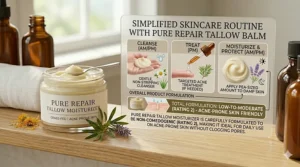
Step 1: Start with a completely clean face. Tallow applied over sunscreen, makeup residue, or pollutants from the day will trap all of that into your pores. Double-cleanse if needed.
Step 2: Dampen your skin before applying. This is the single most important tip, and most people skip it. Tallow is an occlusive — it seals moisture in, but it doesn’t add water. Applied to dry skin, it seals in… nothing, and can actually increase transepidermal water loss over time. Apply your tallow to skin that’s still slightly damp after cleansing, or after a hydrating toner.
Step 3: Use a microscopic amount. We’re talking the size of a half a pea for your entire face. Warm it between your fingertips for 10 seconds until it liquefies, then press and pat — don’t rub — into skin. Rubbing can push the fat into pore openings.
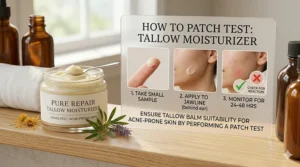
Step 4: Start with one area only. Your jawline or cheeks. Not your T-zone. Give it 2 full weeks before expanding application. This is how you identify whether your skin tolerates tallow before committing your whole face.
Step 5: Night-only for the first 30 days. Daytime tallow + closed indoor environments (offices, gyms) + your natural sebum production can add up to too much. Start nocturnal. Expand to daytime only if nighttime goes well.
Common mistakes in the first 30 days:
- Applying too much (the most common error by far)
- Using it on fully dry skin without a hydrating base
- Starting full-face immediately
- Expecting results in 72 hours — tallow works on the barrier level, which means a 3-4 week minimum before judgment
- Using a formula with essential oils you’ve never patch-tested
Who Should — and Shouldn’t — Use Tallow Moisturizer for Acne Prone Skin
Real-World Profiles: Matching the Right Formula to You
Profile 1: The Over-Stripped Acne Fighter — You’ve been on benzoyl peroxide, retinoids, or prescription antibiotics. Your skin is tight, flaky, red, and sometimes still breaking out despite aggressive treatment. Your acne isn’t caused by excess oil; it’s caused by a compromised barrier that can’t regulate sebum production anymore.
Best match: AMBER ESSENTIALS Tallow and Honey Balm or Vintage Tradition Unscented. Your priority is barrier repair, not more active ingredients. Use these as a nighttime occlusive layer over a ceramide serum.
Profile 2: The Stress & Hormonal Breakout Type — Your skin is mostly clear but flares up cyclically — around your period, after deadline weeks, during travel. Your skin texture is normal to combination. You’re not dealing with constant congestion.
Best match: House of A31 CalmGlow (Lavender Vanilla) or Primally Pure Everything Balm. Lavender’s adaptogenic properties and the linoleic acid from emu oil (in the Primally Pure) address both the inflammatory component and the sebum regulation aspect of hormonal acne.
*Profile 3: The Oily-Acne Skeptic — You produce significant sebum. Your pores are visibly enlarged. You’ve clogged your pores with every “natural” moisturizer you’ve tried. You’re reading this article mostly out of curiosity.
Best match: Citrus Breeze Tallow Honey Balm, applied to damp skin in the absolute minimum amount, T-zone avoided. Or don’t use tallow on your face at all — that’s also a valid choice for your skin type, and one the science actually supports.
Profile 4: The Sensitive Skin Reactor — Everything breaks you out. Fragrance, essential oils, plant extracts, synthetic emollients. You’ve had reactions to products that worked beautifully on everyone else.
Best match: Vintage Tradition Unscented (two ingredients, zero additives) or House of A31 Unscented formula. Patch test on the inside of your wrist for 72 hours before any facial application.
Tallow vs. Traditional Acne Moisturizers: What the Science Actually Says
| Factor | Tallow Moisturizer | Conventional Acne Moisturizer |
|---|---|---|
| Fatty Acid Match to Sebum | Moderate (similar but not identical) | Variable (often synthetic or plant-derived) |
| Comedogenic Rating | 2–3 (moderate) | 0–2 (varies widely by formula) |
| Vitamin Content | Natural A, D, E, K | Added synthetics (often more stable) |
| Preservatives | None (shorter shelf life) | Typically present |
| Ingredient Count | 1–5 typically | Often 20–40 |
| Fragrance Risk | Low (if unscented) | Moderate to high (synthetic fragrances common) |
| Dermatologist Consensus | Split | Generally supported for acne prone skin |
| Best For | Barrier-damaged, dry-acne skin | Oily, congestion-driven acne |
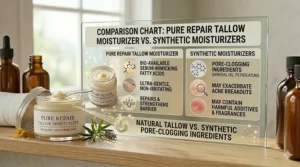
The table above is honest about something tallow advocates don’t always admit: conventional acne moisturizers — particularly those formulated with niacinamide, ceramides, and hyaluronic acid — have significantly more peer-reviewed clinical evidence behind them for acne prone skin than tallow does. According to the American Academy of Dermatology, non-comedogenic, fragrance-free moisturizers are an essential part of any acne treatment regimen. Tallow products that carry a comedogenic rating of 2–3 don’t technically qualify as “non-comedogenic” in the clinical sense.
What tallow does offer that conventional moisturizers don’t: a completely synthetic-free ingredient profile, no preservatives, and fat-soluble vitamins in their whole-food form rather than isolated lab additions. For a growing number of people who react to the preservatives, fragrances, or synthetic emollients in conventional products, tallow fills a real gap. The science supports it as a conditionally suitable moisturizer for acne prone skin — not a universal solution, but a legitimate tool for the right skin profile.
Research from the National Institutes of Health (NIH) confirms that linoleic acid deficiency in skin surface lipids is correlated with acne severity — and tallow formulas that supplement with linoleic-acid-rich oils (like the emu oil in Primally Pure’s Everything Balm) address this mechanism directly.
✨ Don’t Miss These Exclusive Deals!
🔍 Ready to try tallow skincare for acne prone skin?
Click any product name in this article to check current pricing and availability. All seven picks are available on Amazon and represent a range of budgets, formulations, and skin profiles. Make sure to start small and patch test first!
How to Choose the Right Tallow Moisturizer for Acne Prone Skin: 6 Criteria That Actually Matter
1. Know Your Acne Type Before Buying Anything
This is the step most buyers skip. Not all acne is the same. Barrier-damaged, dehydrated acne responds completely differently to tallow than oil-driven, congested acne does. If your T-zone is chronically shiny and your pores are visibly enlarged, a heavy tallow balm is a risk. If your skin feels tight, red, and sensitive alongside breakouts, tallow might be exactly what you need.
2. Check the Fatty Acid Extras, Not Just “Grass-Fed”
Grass-fed is a quality marker, not a formula differentiator. What matters more is whether the formula supplements tallow’s oleic-heavy profile with linoleic acid sources — emu oil, rosehip oil, sea buckthorn — that better serve acne prone skin’s specific deficiencies. Products that are pure tallow or tallow + olive oil (also high oleic) carry higher comedogenic risk than those blended with linoleic-acid-rich additions.
3. Essential Oils: Friend or Foe?
Tea tree and lavender? Generally skin-beneficial for acne. Citrus essential oils? Photo-sensitizing — only use at night or always follow with SPF. Fragrance blends, undisclosed “aroma compounds,” or high concentrations of any essential oil? Potentially irritating for reactive skin. If you know you’re EO-sensitive, go unscented without exception.
4. Rendering Method: Wet vs. Dry
Wet-rendered tallow (cooked in water) generally retains more water-soluble nutrients but has a slightly shorter shelf life. Dry-rendered (pure heat, no water) produces a cleaner, more shelf-stable product with a slightly higher smoke point. For skincare purposes, wet-rendered tends to have a slightly richer nutrient profile. Brands like Vintage Tradition emphasize traditional wet rendering for this reason.
5. Size vs. Trial — Know What You’re Buying Into
A 2 oz jar at $22–$28 is a better first purchase than a 4 oz jar at $30–$38, even if the per-ounce math doesn’t favor it. With acne prone skin, your reaction window is 4–6 weeks minimum. Committing to a large quantity before you know how your skin responds is an expensive gamble. Start small. Scale up on products that work.
6. Read the Negative Reviews — But Read Them Critically
One-star reviews that say “broke me out immediately” are worth reading, but note: most of these result from applying too much, skipping damp-skin prep, or using on skin types that dermatology literature consistently cautions about (very oily, fungal-acne-prone, or sebum-heavy). The application method matters as much as the formulation.
Common Mistakes When Buying Tallow Moisturizer for Acne Prone Skin
Mistake 1: Choosing “Pure” Tallow When You Have Oily Skin Pure, single-ingredient tallow is appropriate for dry or barrier-damaged skin. For genuinely oily, acne prone skin, you want a formula that dilutes the oleic acid content with linoleic-rich additions. Reach for blended formulas like the Primally Pure Everything Balm or ABOUME’s honey-beeswax version.
Mistake 2: Expecting an Acne Treatment (It’s a Moisturizer) Tallow won’t clear acne the way benzoyl peroxide or tretinoin will. What it can do is stop your barrier from being the reason your acne treatments aren’t working. Pair it with your existing acne actives — don’t replace them with it, at least not immediately.
Mistake 3: Skipping the Patch Test Because “It’s Natural” Natural does not mean non-reactive. Oleic acid, essential oils, and even raw honey are documented allergens for a subset of people. Test on your inner forearm for 48–72 hours before applying anywhere near your face.
Mistake 4: Applying Over Sunscreen Remnants Tallow applied over incompletely removed sunscreen or makeup is a recipe for clogged pores. Always apply to freshly cleansed skin. Always.
Mistake 5: Judging Results in Under Three Weeks Skin barrier repair is a slow process. The American Academy of Dermatology notes that barrier-focused skincare typically shows measurable improvement after 4 weeks of consistent use. If you’re evaluating tallow after five days, you’re not evaluating it; you’re just meeting it.
Tallow Moisturizer for Acne Prone Skin: What to Expect in Weeks 1–8
Week 1–2 can be confusing. Some users experience a purging-like response as the occlusive barrier effect changes how skin expels debris. This is not universal, but it happens — particularly with over-stripped skin suddenly being given a protective layer for the first time in months. The adjustment period is real.
Week 3–4 is where most users notice the first genuine positive changes. Redness tends to soften. Tight, dry patches between breakouts start to feel more comfortable. The skin stops oscillating between oily and tight in the same manic way.
Week 5–8 is the real assessment window. By this point, you’ll know whether your skin type is compatible with tallow. Users who see continued improvement are typically those with barrier-damaged or combination-dry acne. Users who experience ongoing congestion or new comedones likely have the oil-driven acne type that benefits more from linoleic-acid-forward formulas or conventional non-comedogenic moisturizers instead.
The National Institutes of Health (NIH) research on skin barrier lipids underscores that long-term barrier support reduces the inflammatory signaling that drives breakouts — but that same research confirms this mechanism is most relevant when barrier disruption (not sebum overproduction) is the primary acne driver.
Price & Value Analysis: Finding the Right Tallow Moisturizer for Your Budget
| Tier | Products | Price Range | Best For |
|---|---|---|---|
| Budget | Citrus Breeze Tallow Balm, AMBER ESSENTIALS | $16–$26 | First-time buyers, patch testers |
| Mid-Range | ABOUME Tallow Honey Balm, House of A31 Rose/Calm | $20–$30 | Regular users with established routine |
| Premium | Primally Pure Everything Balm, Vintage Tradition | $28–$38 | Long-term users, sensitive/reactive skin |
The value calculation here runs deeper than price per ounce. The budget options are excellent for testing your skin’s response without financial commitment. The mid-range options offer the best balance of thoughtful formulation and accessible pricing — ABOUME’s 4.2 oz jar at $22–$30 likely offers the best volume-adjusted value on the entire list. The premium tier earns its price through sourcing transparency, regenerative farm credentials, and more sophisticated ingredient layering (particularly Primally Pure’s emu oil addition).
One practical note: tallow balms have a shelf life of 6–12 months without preservatives. Buying the largest size only makes economic sense if you’ll use it within that window.
FAQ: Tallow Moisturizer for Acne Prone Skin
❓ Is tallow moisturizer safe for acne prone skin?
❓ Can tallow clog pores and make acne worse?
❓ What is the best rendered tallow face balm for acne prone skin?
❓ How do I use an organic tallow facial moisturizer without breaking out?
❓ Does tallow oil cleansing work for acne prone skin?
Conclusion: Should You Try Tallow Moisturizer for Acne Prone Skin?
Here’s the truth without the TikTok spin: tallow moisturizer is not a universal skincare solution, and it’s certainly not the acne cure that some corners of the internet will have you believe. But dismissing it entirely misses something real.
For acne prone skin that’s primarily driven by barrier damage — over-treated, dehydrated, reactive, or caught in the stripped-then-oily cycle — tallow offers something genuinely hard to find: a minimal-ingredient, synthetic-free, fat-soluble vitamin-rich occlusive that supports the repair mechanisms skin needs. Used correctly, in the right amount, on damp skin, at night, it can be the missing piece in a frustrating skincare puzzle.
For oil-driven, congested, sebum-heavy acne prone skin — the kind where pores are visibly enlarged and breakouts are constant regardless of what you put on your face — tallow carries real comedogenic risk. The science is clear on that. It’s not the villain some claim, but it’s not a guaranteed hero either.
The seven products reviewed in this guide represent the best currently available on Amazon across a range of formulations, price points, and skin profiles. Start with the smallest, most targeted option for your type. Patch test. Apply less than you think you need. Give it four weeks before passing judgment. And remember that tallow is a moisturizer — a potentially excellent one for the right person — not a medication.
Your skin’s relationship with beef fat is, ultimately, deeply personal.
✨ Don’t Miss These Exclusive Deals!
🔍 Ready to find your perfect tallow match?
Click on any highlighted product to check current pricing and availability on Amazon. Whether you’re a first-time buyer or a tallow convert looking to upgrade, there’s a formula for every skin type in this guide. Start your cleaner skincare chapter today!
Recommended for You
- 7 Best Grass-Fed Tallow Balm Face Picks That Actually Work (2026)
- Best Skin Barrier Ceramide Complex: 7 Proven Picks (2026)
- 7 Best Ceramide Moisturizer Dry Skin Barrier Picks (2026)
Disclaimer: This article contains affiliate links. As an Amazon Associate, I earn from qualifying purchases. If you purchase products through these links, we may earn a small commission at no additional cost to you.
✨ Found this helpful? Share it with your friends! 💬🤗
