
In This Article
One day your kid has clear skin. A few months later, there’s a constellation of red bumps across their forehead and jawline that seems to refill itself overnight no matter what face wash you buy at the drugstore. If this sounds familiar, you’re not imagining it, and it’s not because anyone is “doing skincare wrong.
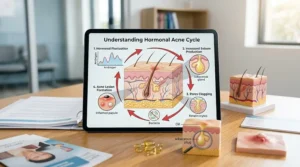
Hormonal teenage acne treatment starts with understanding what’s actually happening under the skin: rising androgen hormones during puberty signal the sebaceous glands to pump out more oil (sebum), which mixes with dead skin cells and bacteria to clog pores. According to Nemours KidsHealth, acne affects roughly 85% of teenagers at some point, which makes it one of the most universal — and most over-treated-with-the-wrong-stuff — skin conditions out there.
The good news is that you don’t need a dermatologist visit to make real progress. A handful of over-the-counter ingredients (benzoyl peroxide, salicylic acid, and adapalene chief among them) have decades of clinical backing and are sold right on Amazon. The hard part is knowing which formula, strength, and format actually fits a teenager’s skin instead of triggering the dryness and irritation that makes them quit after a week. That’s what we’re sorting out below — based on real products, real ingredient breakdowns, and what’s actually worth the money.
Quick Comparison: 7 Hormonal Acne Treatments at a Glance
| Product | Type | Key Active | Best For |
|---|---|---|---|
| Neutrogena Oil-Free Acne Wash | Cleanser | 2% Salicylic Acid | Budget daily cleanser, oily skin |
| CeraVe Acne Foaming Cream Cleanser | Cleanser | 4% Benzoyl Peroxide | Sensitive skin needing barrier support |
| Differin Adapalene Gel 0.1% | Leave-on gel | Adapalene (retinoid) | Long-term breakout prevention |
| La Roche-Posay Effaclar BPO Multi-Target Treatment | Spot/leave-on | 5.5% Micronized Benzoyl Peroxide | Fast-acting, sensitive-skin-tested |
| Paula’s Choice 2% BHA Liquid Exfoliant | Leave-on liquid | 2% Salicylic Acid | Blackheads, texture, clogged pores |
| Mighty Patch Original | Hydrocolloid patch | None (physical absorption) | Whiteheads, overnight emergencies |
| COSRX Acne Pimple Master Patch | Hydrocolloid patch | None (physical absorption) | Budget patches, daytime cover |
A quick read on this table: the two cleansers (Neutrogena and CeraVe) aren’t interchangeable despite looking similar on the shelf — one uses salicylic acid to exfoliate inside the pore, the other uses benzoyl peroxide to kill acne-causing bacteria, and CeraVe’s ceramide-heavy formula is built specifically for skin that reacts badly to drying actives. Meanwhile, the patches don’t compete with any of the leave-on treatments at all; they’re a same-day fix for a single inflamed bump, not a routine. If your teen is dealing with widespread breakouts rather than the occasional flare-up, the leave-on treatments and cleansers are doing the real long-term work.
💬 Just one click — help others make better buying decisions too!😊
✨ Don’t Miss These Exclusive Deals!
🔍 Take your skincare routine to the next level with these dermatologist-tested products. Click on any highlighted item to check current pricing and availability — these picks help teens get clearer, calmer skin without the trial-and-error.
The Top 7 Hormonal Teen Acne Products: Expert Breakdown
1. Neutrogena Oil-Free Acne Wash
Neutrogena Oil-Free Acne Wash is the drugstore staple that’s been recommended by dermatologists for years, and for a face wash that costs less than a movie ticket, it earns that reputation. The active ingredient is 2% salicylic acid, a beta-hydroxy acid that’s oil-soluble — meaning it can actually slip into a clogged, oily pore rather than just sitting on the surface like most acids do. In practice, that means it’s working on blackheads and the early, not-yet-visible clogs while it cleans, not just removing dirt.
What most buyers overlook about this one: a cleanser only has 30–60 seconds of contact time before it’s rinsed away, so it’s never going to do the heavy lifting that a leave-on treatment does. Think of it as the “prep” step that keeps pores from re-clogging between treatments, not the cure on its own. It pairs well with literally any leave-on product on this list.
Customer feedback consistently flags it as gentle enough for daily use but strong enough to notice a difference within a couple of weeks, with a smaller subset of reviewers with very dry or sensitive skin reporting tightness.
✅ Pros: Extremely affordable, widely available in multiple formula variants (fragrance-free version exists), proven active ingredient
✅ Best for: Teens with oily-to-normal skin doing a simple two-step routine
❌ Cons: Can be drying for already-sensitive skin; the foaming/scrub versions can be too abrasive for inflamed acne
Price range: budget tier, generally under $15 depending on size and pack count.
2. CeraVe Acne Foaming Cream Cleanser
CeraVe Acne Foaming Cream Cleanser takes a completely different approach than the Neutrogena wash above: instead of salicylic acid, it uses 4% benzoyl peroxide, an ingredient that works by directly reducing the acne-causing bacteria on the skin’s surface rather than exfoliating inside the pore. In real-world terms, that makes it a better pick for inflamed, red, “angry” looking breakouts rather than blackheads.
The detail that’s easy to miss on the label: this is formulated with three ceramides and hyaluronic acid specifically because benzoyl peroxide has a reputation for being harsh. CeraVe’s version is built to fight that reputation — it transforms from a cream into a light foam, which is gentler on the skin barrier than a stripped-feeling gel formula. For a teenager who tried benzoyl peroxide before and quit because their face felt raw, this is the version worth trying again.
Reviewers frequently mention it as a good “first benzoyl peroxide” product because it doesn’t leave the tight, flaky feeling that cheaper 10% formulas can cause.
✅ Pros: Dermatologist-developed, ceramide barrier support, gentler than most BP cleansers
✅ Best for: Teens with inflamed, red breakouts and reactive or combination skin
❌ Cons: Benzoyl peroxide can bleach colored towels and pillowcases; some buildup of dryness if overused
Price range: mid-tier, typically in the $12–$18 range.
3. Differin Adapalene Gel 0.1%
Differin Adapalene Gel 0.1% is the single biggest shift in OTC acne care in the last generation — adapalene was the first new acne active ingredient available without a prescription in over 30 years, and it works completely differently from anything else on this list. It’s a retinoid, meaning it speeds up skin cell turnover so pores don’t get clogged in the first place, rather than treating breakouts after they appear.
Here’s what most people get wrong with this one: it’s not a spot treatment. You apply a thin layer over the entire face nightly, even on clear skin, because its real power is in prevention. It typically takes 4–8 weeks of consistent use before results show, and many people see things look slightly worse in week 2–3 (the dreaded “purge”) before they get dramatically better. For a teenager who wants instant results, that delay is a real psychological barrier — set the expectation up front or they’ll quit at the worst possible time.
In clinical testing referenced by the manufacturer, consistent daily use showed meaningful reduction in acne lesions by week 12, which lines up with what most dermatologists tell patients to expect from any retinoid.
✅ Pros: Prevents future breakouts (not just spot-treats), gentler than prescription retinoids, backed by the most acne research of anything OTC
✅ Best for: Teens with recurring, widespread breakouts who can commit to a nightly routine
❌ Cons: Slow to show results; requires daily SPF use; not a quick fix for an event tomorrow
Price range: mid-to-premium, generally $15–$25 depending on tube size and supply length.
4. La Roche-Posay Effaclar BPO Multi-Target Acne Treatment
La Roche-Posay Effaclar BPO Multi-Target Acne Treatment is the French-pharmacy answer to American drugstore benzoyl peroxide — and the formulation choices show it. Instead of standard 10% benzoyl peroxide, it uses 5.5% micronized benzoyl peroxide, meaning the particles are milled smaller so they penetrate the pore more efficiently at a lower, less irritating concentration.
What stands out in practical use: it’s paired with glycerin and silica, which is the brand’s way of countering the drying reputation benzoyl peroxide normally carries. For a teen with sensitive or easily-irritated skin who still needs something stronger than salicylic acid alone, this is positioned exactly in that gap — meaningfully active, but tested specifically for sensitive skin types rather than just “tolerable.”
Brand-reported testing on the line indicates a noticeable reduction in blemishes within about 10 days of consistent use, which tracks with how fast micronized benzoyl peroxide formulas tend to perform compared to standard BP.
✅ Pros: Lower-irritation benzoyl peroxide formula, dermatologist-developed, works as spot treatment or all-over
✅ Best for: Sensitive skin that’s reacted badly to standard benzoyl peroxide before
❌ Cons: Premium price point for the size; benzoyl peroxide bleaching risk still applies to fabrics
Price range: premium tier, typically $20–$30.
5. Paula’s Choice Skin Perfecting 2% BHA Liquid Exfoliant
Paula’s Choice Skin Perfecting 2% BHA Liquid Exfoliant is less a “treatment” and more a maintenance tool — but it’s become one of the most reviewed skincare products in existence for a reason. Like the Neutrogena wash, the active is 2% salicylic acid, but because this is a leave-on liquid instead of a rinse-off cleanser, it gets far more contact time with the pore, which translates to noticeably better results on blackheads and rough, bumpy texture.
The detail worth understanding: this product is not formulated to fight active, inflamed pimples the way benzoyl peroxide does — its job is unclogging and preventing, which makes it most effective as a long-game product layered after cleansing and before moisturizer. Teens expecting it to zap a current breakout overnight will be disappointed; teens using it consistently for clogged pores and post-acne texture tend to become repeat buyers for years.
It’s consistently one of the highest-rated leave-on exfoliants for sensitive skin specifically because the formula was built to be non-abrasive, with no added fragrance.
✅ Pros: Cult-favorite formula with strong long-term track record, no fragrance, gentle enough for daily use
✅ Best for: Persistent blackheads, clogged pores, and rough texture rather than active inflamed pimples
❌ Cons: Doesn’t replace a benzoyl peroxide or adapalene product for inflammatory acne; can increase sun sensitivity
Price range: mid-tier, typically $18–$32 depending on bottle size.
6. Mighty Patch Original (Hero Cosmetics)
Mighty Patch Original isn’t a treatment in the traditional sense — there’s no active ingredient at all. It’s medical-grade hydrocolloid, the same wound-care material hospitals use, shaped into a small sticker that physically absorbs fluid from a pimple overnight. It became the best-selling beauty product on Amazon for a reason: it’s the closest thing to instant gratification in this entire category.
What it’s genuinely good at: shrinking the appearance of a whitehead — a pimple that’s already come to a head with visible fluid or pus — usually within 6–8 hours of overnight wear. What it can’t do, and what a lot of buyers don’t realize until they’re disappointed: it does nothing for blackheads, deep cystic bumps, or hormonal breakouts that haven’t surfaced yet, because there’s no fluid for the hydrocolloid to pull out.
The honest use case here is damage control for picking and popping, not skincare. If a teenager is going to mess with a pimple anyway, this turns that habit into something that actually helps healing instead of causing scarring.
✅ Pros: Visible results in hours, zero irritation risk, also doubles as a barrier against picking
✅ Best for: Single emergency whiteheads, prom-night or photo-day situations
❌ Cons: Useless on blackheads or unsurfaced cystic acne; doesn’t address the underlying hormonal cause at all
Price range: mid-tier, typically $10–$13 for a 36-count box.
7. COSRX Acne Pimple Master Patch
COSRX Acne Pimple Master Patch does almost exactly what Mighty Patch does — same hydrocolloid technology, same “absorb the fluid overnight” mechanism — but at a noticeably lower price per patch, and with one practical difference: the box includes three sizes in one sheet, so a single pack can cover everything from a tiny chin bump to a larger cheek breakout.
What’s easy to miss when comparing this to Mighty Patch: COSRX’s patches are registered as an FDA medical device for wound protection, which is the same underlying classification, but the brand leans into a thinner, more “barely there” feel that some users find blends in better under makeup. The trade-off is usually adhesion — several long-time users of both brands note that COSRX’s patches are slightly less aggressive at staying put through a full night of tossing and turning than Hero’s.
Reviewers most often reach for this brand specifically because of the price-per-patch math when treating multiple spots regularly, rather than the occasional single emergency.
✅ Pros: Three sizes per sheet, lower cost per patch than premium brands, suitable for face and body
✅ Best for: Budget-conscious buyers who patch multiple spots regularly, not just occasionally
❌ Cons: Slightly less adhesive than premium competitors; same blackhead/cystic limitations as all hydrocolloid patches
Price range: budget tier, typically $6–$10 for a multi-size pack.
Practical Usage Guide: Building a Teen Acne Routine That Actually Works
Buying the right product is half the battle — using it correctly is the other half, and it’s where most teenage skincare routines quietly fail.
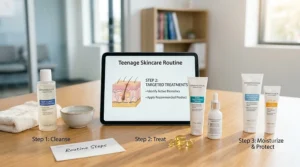
Start with one new active ingredient at a time. Introducing a salicylic acid cleanser, a benzoyl peroxide treatment, and a retinoid all in the same week is the single most common mistake that leads to a red, flaking, miserable face by day four — and then a teenager who refuses to try skincare again for six months. Add one product, wait one to two weeks, and only then layer in the next.
Apply leave-on treatments (Differin, the Effaclar BPO treatment, the BHA exfoliant) to completely dry skin. Both benzoyl peroxide and adapalene are more likely to irritate damp skin, and dermatologists commonly recommend waiting a full 20–30 minutes after washing before applying a retinoid for exactly this reason.
Moisturizer and sunscreen are not optional add-ons — they’re what makes the active ingredients tolerable long-term. Every single active on this list (salicylic acid, benzoyl peroxide, and especially adapalene) increases sun sensitivity or dryness, and skipping moisturizer is the fastest route to a flaking, irritated mess that gets blamed on the acne product instead of the missing step.
Expect a “purge” period in weeks 2–4 with both benzoyl peroxide and adapalene, where things can look slightly worse before they look better — this is the product clearing out congestion that was already forming under the skin, not a sign the product is failing.
Real-World Scenarios: Matching the Right Product to Your Teen’s Skin
The athlete with back and chest breakouts: Frequent sweating and tight athletic gear are a classic combination for body acne. A salicylic acid wash like Neutrogena’s, used in the shower right after practice, paired with the COSRX patches for stubborn spots between games, tends to be the lowest-effort routine that still gets results.
The “picker” with scarring concerns: If a teen can’t leave a breakout alone, the priority isn’t necessarily the strongest active ingredient — it’s interrupting the habit. Mighty Patch or COSRX patches double as a physical barrier, and pairing that with Differin at night (which also helps fade the marks picking leaves behind) tends to outperform a more aggressive routine that gets sabotaged by picking anyway.
The sensitive-skin teen who’s “tried everything”: If past benzoyl peroxide or salicylic acid products have caused redness or burning, the CeraVe cleanser and La Roche-Posay’s micronized BP treatment are specifically formulated to lower that irritation ceiling. Starting here, every other day rather than daily, is a more sustainable entry point than going straight to a 10% benzoyl peroxide product.
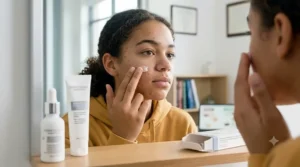
How to Choose a Hormonal Acne Treatment for Teens
- Identify the dominant acne type first. Blackheads and clogged pores respond best to salicylic acid (Neutrogena, Paula’s Choice). Red, inflamed pimples respond best to benzoyl peroxide (CeraVe, La Roche-Posay). Widespread, recurring breakouts benefit most from a retinoid (Differin) for long-term prevention.
- Match strength to skin sensitivity, not to “what works fastest.” The FDA’s OTC drug monograph permits benzoyl peroxide anywhere from 2.5% to 10% and salicylic acid from 0.5% to 2% — but a 10% benzoyl peroxide product isn’t automatically better than a 4% one, it’s just more likely to cause irritation that derails the whole routine.
- Decide if you need a routine or a rescue tool. Cleansers and leave-on treatments are routines that take weeks to show full results. Hydrocolloid patches are rescue tools for a single spot, not a substitute for daily treatment.
- Check for fragrance and comedogenic ingredients if skin is already reactive — every product reviewed here is fragrance-free or formulated specifically for acne-prone skin, which isn’t true of plenty of products on the shelf next to them.
- Plan for at least 6–8 weeks before judging results. Almost every effective acne ingredient takes a full skin cycle (about 4–6 weeks) to show meaningful change, and most people quit around week 2–3, right when the “purge” period is most discouraging.
Common Mistakes Parents and Teens Make When Buying Acne Products
The biggest one is chasing the highest percentage of active ingredient, assuming “stronger is faster.” In reality, irritation from a too-strong product is the number one reason teens abandon a routine before it has time to work — a 4% benzoyl peroxide used consistently for 8 weeks will usually outperform a 10% formula that gets used for four days and then quit on.
A close second is treating acne only with spot treatments while skipping a daily routine entirely. Hydrocolloid patches and spot gels are reactive — they deal with what’s already visible. Without a cleanser and leave-on treatment running in the background, new breakouts keep forming at the same rate they’re being treated, which feels like “nothing is working” when really nothing preventive is being used.
A third common mistake is stacking too many active ingredients at once — salicylic acid cleanser, benzoyl peroxide treatment, and a BHA exfoliant all in one routine is a recipe for a compromised skin barrier, not faster results.
Features That Actually Matter (And the Marketing Hype to Ignore)
What matters: the active ingredient and its concentration, fragrance-free formulation, and whether the product is positioned as a leave-on treatment versus a rinse-off cleanser. These three factors predict real-world performance far better than brand name or packaging.
What doesn’t matter nearly as much as marketing suggests: “detox,” “purifying,” and “deep clean” language on cleansers — there’s no clinical mechanism behind most of these claims, and a basic salicylic acid or benzoyl peroxide formula will outperform a fragranced “detox” wash every time. Charcoal and clay as headline ingredients are similarly more about texture and marketing appeal than measurable acne-fighting power compared to the ingredients reviewed above.
How Long Until You See Results — and What It Actually Costs Over Time
Most teens see the first signs of improvement (less new breakout activity, slightly calmer redness) within 2–4 weeks of consistent use. Full results from a retinoid like Differin typically take 8–12 weeks. Patches work in hours but only on the single spot they’re covering.
On cost: a basic two-step routine (a salicylic acid or benzoyl peroxide cleanser plus a leave-on treatment) typically runs in the $25–$45/month range when you account for how long a bottle lasts with twice-daily use. That’s meaningfully cheaper than recurring dermatologist copays for mild-to-moderate acne, though a dermatologist visit becomes worth the cost quickly if OTC products aren’t moving the needle after 2–3 months of consistent use.
When to See a Dermatologist Instead of Trying Another Product
Over-the-counter treatment is genuinely effective for mild-to-moderate acne, but it has limits. According to the American Academy of Dermatology’s most recent clinical guidelines, persistent or worsening acne — especially deep, painful cysts or nodules, or any acne leaving dark marks or scarring — responds better to prescription-strength treatment than to stronger OTC products. A clinical review on adolescent acne notes this is especially true when breakouts don’t respond to a consistent OTC routine within a couple of months. If a routine hasn’t shown improvement after 2–3 months, or if breakouts are large, painful, or scarring, that’s the point to involve a dermatologist rather than escalating to a higher percentage of the same OTC ingredient.

Frequently Asked Questions
❓ What causes hormonal acne in teenagers?
❓ Is benzoyl peroxide or salicylic acid better for teen acne?
❓ How long does it take for adapalene gel to work on teenage acne?
❓ Can teenagers use the same acne products as adults?
❓ Do pimple patches actually work for hormonal acne?
Conclusion: Clear Skin Is a Routine, Not a Single Product
There’s no single “best” hormonal teenage acne treatment because hormonal acne isn’t one problem — it’s blackheads, inflamed pimples, clogged pores, and the occasional emergency whitehead, often all happening at once on the same face. The teens who see the most consistent improvement aren’t the ones who found one miracle product; they’re the ones running a simple two-step routine (a gentle active cleanser plus one leave-on treatment) consistently for two to three months, with a patch on hand for emergencies.
Start with whichever product above matches the dominant acne type, give it a real trial period before judging it, and don’t be afraid to dial back to a gentler formula if skin protests. Clearer skin is almost always a patience problem before it’s a product problem.
✨ Don’t Miss These Exclusive Deals!
🔍 Ready to build a routine that actually fits your skin? Check current pricing and availability on the products above — small, consistent steps make the biggest difference over a few months.
Recommended for You
- Skincare Routine for 13 Year Old: 7 Gentle Must-Haves (2026)
- 7 Best Pregnancy Approved Brightening Serums for Glowing Skin (2026)
- 7 Safe Skincare Picks for a Pregnancy Routine That Actually Works (2026)
Disclaimer: This article contains affiliate links. As an Amazon Associate, I earn from qualifying purchases. If you purchase products through these links, we may earn a small commission at no additional cost to you.
✨ Found this helpful? Share it with your friends! 💬🤗
