
In This Article
There’s a specific kind of frustration that comes with retinol. You hear about its legendary wrinkle-fighting powers, you buy the bottle, and then your face spends the next two weeks looking like it lost a fight with sandpaper. Peeling, redness, that lovely “retinol purge” phase nobody mentions in the ads. Sound familiar?
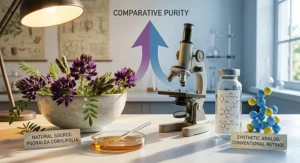
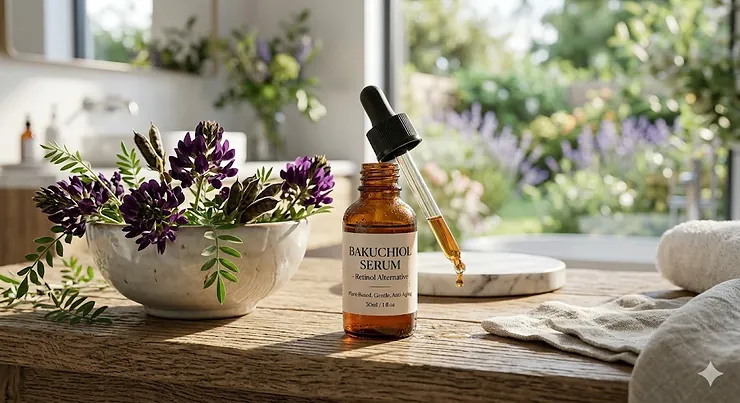
That’s exactly why the bakuchiol serum retinol alternative has become one of the most-searched skincare topics of 2026. Bakuchiol (pronounced buh-KOO-chee-all) is a plant-derived compound extracted from the seeds of Psoralea corylifolia — the babchi plant, a staple of Ayurvedic medicine for centuries. The modern skincare world caught up only recently, and when it did, the results were hard to ignore.
Here’s the quick version: a landmark double-blind, 12-week clinical trial published in the British Journal of Dermatology found that bakuchiol and retinol produced comparable improvements in fine lines, wrinkles, skin firmness, and hyperpigmentation. The difference? The retinol group reported significantly more facial scaling and stinging. Bakuchiol delivered the results. Without the punishment.
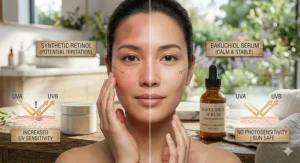
What makes it genuinely special as a bakuchiol serum retinol alternative is its versatility. It’s safe for daytime use (retinol degrades in sunlight). It won’t make your skin sun-sensitive. And for anyone who is pregnant or breastfeeding? It’s one of the very few effective anti-aging actives considered safe during pregnancy — something retinol most definitely is not, as noted by the American Academy of Dermatology.
In this guide, you’ll find the 7 best bakuchiol serums currently available on Amazon, what actually separates a great formula from a mediocre one, and exactly how to fold this ingredient into your routine for maximum results. Let’s get into it.
Quick Comparison: 7 Best Bakuchiol Serums at a Glance
| Product | Bakuchiol % | Key Extras | Price Range | Best For |
|---|---|---|---|---|
| HERBIVORE Moon Fruit Serum (Regular) | 0.5% | Peptides | $28–$38 | Clean beauty fans |
| HERBIVORE Moon Fruit Serum (Extra Strength) | 1% | Peptides | $32–$42 | Experienced users |
| Beekman 1802 Dream Booster | Not disclosed | Sunflower, Squalane, Jojoba | $22–$28 | Ultra-sensitive skin |
| Paula’s Choice 0.3% Retinol + 2% Bakuchiol | 2% + 0.3% Retinol | Peptides, Ceramides, Vitamin C | $52–$62 | Advanced anti-aging |
| Naturium Retinol Complex Serum | Undisclosed | Encapsulated Retinol, Murumuru Butter | $18–$24 | Budget-conscious shoppers |
| BYBI Bakuchiol Booster (1% in Squalane) | 1% | Olive Squalane | $18–$24 | Minimalists / layering |
| +1HEROLABS Bakuchiol Plumping Serum | 5,000 ppm | Collagen, Witch Hazel, Centella | $15–$22 | Beginners & budget |
Reading this table: Paula’s Choice is the obvious outlier — it contains actual retinol alongside bakuchiol, making it the best choice for those who can tolerate retinoids but want amplified results. If you’re retinol-sensitive or want a pure plant-based route, HERBIVORE and Beekman 1802 are the stronger options. Budget shoppers will get serious mileage from +1HEROLABS and Naturium without spending anywhere near premium prices.
💬 Just one click — help others make better buying decisions too! 😊
✨ Don’t Miss These Exclusive Deals!
🔍 Ready to transform your skincare routine? Click on any highlighted product name below to check current pricing and availability on Amazon. These bakuchiol picks are among the best-reviewed in their category right now! 😊
Top 7 Bakuchiol Serum Retinol Alternatives: Expert Analysis
1. HERBIVORE Botanicals Moon Fruit Bakuchiol + Peptides Retinol Alternative Face Serum (Regular Strength)
If clean beauty had a crown jewel, HERBIVORE’s Moon Fruit serum might be wearing it. The regular-strength version packs 0.5% bakuchiol alongside a multi-peptide blend in a lightweight, gel-like texture that’s genuinely enjoyable to apply — not just tolerable.
The 0.5% concentration is a deliberate design choice, not a shortcoming. For first-time bakuchiol users or anyone transitioning off retinol and wanting to reset their skin barrier, this concentration delivers real results without overstimulating compromised skin. The peptides alongside bakuchiol aren’t just marketing padding — peptides signal fibroblasts to produce more collagen, and pairing them with bakuchiol creates a compound effect on skin firmness that a single active simply can’t match.
What most buyers overlook: this is a glass-bottled, pump-dispensed serum from an FSC-certified box, which means minimal air exposure and minimal waste. Small details that matter for product stability and shelf life.
Customers describe visible smoothing within 4–6 weeks, with many noting reduced pore appearance alongside the expected fine-line improvement.
✅ Genuinely clean, minimal ingredient list
✅ Lightweight texture works under makeup and SPF
✅ Sustainable packaging
❌ 0.5% concentration may feel underwhelming for veteran retinol users
❌ Price feels premium relative to the 30mL bottle size
Price range: $28–$38 |
A well-crafted entry point that earns its spot among serious skincare routines, especially for sensitive or reactive complexions.
2. HERBIVORE Botanicals Moon Fruit Bakuchiol Retinol Alternative Face Serum (Extra Strength)
Same HERBIVORE formula, same aesthetic philosophy — but doubled in concentration. The 1% bakuchiol version is built for people who’ve already done a few months with the regular strength and want to push results further. Think of it as moving from a training run to race pace.
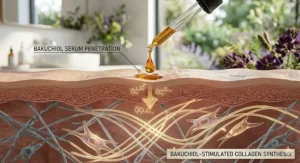
At 1%, you’re entering territory where bakuchiol shows its most impressive collagen-stimulating behavior. The same peptide complex that made the original compelling is still here, but the increased bakuchiol concentration gives the formula a more pronounced effect on deeper lines and skin density over time. In the science, 2019 research in the International Journal of Cosmetic Science found that bakuchiol increased skin firmness by 15% and reduced facial lines by 21% after 12 weeks — that kind of result requires adequate dosing.
Experienced retinol users who are making a permanent switch will find this concentration most comparable to what they were getting from a 0.3%–0.5% retinol.
Buyers report results accelerating noticeably versus the regular strength, with less dryness than retinol at equivalent efficacy.
✅ 1% concentration for visible anti-aging results
✅ Can be used morning and night without sun sensitivity concerns
✅ Elegant texture that layers effortlessly
❌ Higher cost than most competitors at the same 1% concentration
❌ Some very sensitive skin types may need a gradual introduction
Price range: $32–$42
The upgrade pick for anyone who’s already a bakuchiol convert and wants to maximize long-term results.
3. Beekman 1802 Dream Booster Bakuchiol Face Serum for Sensitive Skin
Beekman 1802 has built its entire brand identity around being “Clinically Kind” — and the Dream Booster delivers on that promise in a way that feels almost absurdly gentle. This is the serum I’d hand to anyone who has ever cried a little after trying a retinol product for the first time.
The formula pairs bakuchiol with sunflower oil, jojoba, and squalane — a trio of skin-calming, barrier-reinforcing lipids that contextualize the active ingredient beautifully. The squalane in particular mimics the skin’s own sebum, meaning this serum absorbs like it belongs there rather than sitting on the surface. The brand claims it’s 4x gentler than retinol, and based on the absence of anything remotely irritating in the ingredient deck, that tracks.
Crucially: this formula is explicitly listed as safe for use during pregnancy and breastfeeding, and it’s completely free of parabens, sulfates, phthalates, and synthetic fragrance.
Customers with rosacea and eczema-prone skin rave about this one — which tells you everything about its irritation profile.
✅ Safe for pregnancy and breastfeeding
✅ Fragrance-free, deeply calming formula
✅ Sunflower + jojoba + squalane support the skin barrier
❌ 0.5 fl oz bottle is small — better as a trial or travel size
❌ Bakuchiol concentration not disclosed on packaging
Price range: $22–$28 |
The definitive choice for sensitive, reactive, or pregnancy-safe routines. This one doesn’t gamble with your skin.
4. Paula’s Choice CLINICAL 0.3% Retinol + 2% Bakuchiol Face Serum Treatment
Paula’s Choice plays a different game entirely. Rather than positioning itself as a pure bakuchiol serum retinol alternative, the CLINICAL Treatment uses bakuchiol alongside 0.3% retinol — a synergistic approach backed by the science showing that bakuchiol actually helps stabilize retinol and extends its efficacy.
Let’s talk about those numbers. The 2% bakuchiol concentration here is among the highest you’ll find in a commercially available product, and it’s paired with a clinically meaningful 0.3% retinol dose. Add firming peptides, ceramides for barrier support, hyaluronic acid, and vitamins C and E, and you have a formula that doesn’t just dabble — it commits. In Paula’s Choice clinical panels, 94% of users reported improved elasticity and 90% reported enhanced texture. Those aren’t numbers you make up.
This is a product for someone dealing with more advanced signs of aging — deeper lines, noticeable loss of firmness, persistent hyperpigmentation — who wants a science-forward approach rather than a gentle, natural one.
Use it once or twice daily. Wear SPF in the morning, because the retinol component still requires that.
✅ 2% bakuchiol + 0.3% retinol: the most comprehensive formula on this list
✅ Peptides + ceramides + vitamins C & E in one step
✅94% of users saw improved elasticity in panel studies
❌ Not suitable for pregnancy or retinol-sensitive skin
❌ Premium pricing puts it out of reach for many budgets
Price range: $52–$62 |
The power-user’s pick. If you want the maximum anti-aging output from a single serum, this is your answer.
5. Naturium Retinol Complex Serum (Encapsulated Retinol + Bakuchiol)
Naturium has quietly become one of the most trusted budget-friendly skincare lines in the US, and the Retinol Complex Serum is a prime example of why. Like the Paula’s Choice treatment, it combines bakuchiol with encapsulated retinol — but at a fraction of the price.
The “encapsulated retinol” part is worth unpacking. Encapsulation means the retinol molecules are wrapped in a time-release delivery system that gradually releases the active into the skin, reducing the initial irritation spike that traditional retinol causes. Paired with bakuchiol as a biological complement, this is genuinely smart formulation for the price point.
The serum also contains murumuru seed butter, a rich Amazonian butter that provides emollient support without clogging pores — a welcome addition for anyone with dry, tight skin that retinoids tend to exacerbate.
Naturium recommends it for aging, blemish-prone, and combination skin types, applied three to five times per week at night to start. That cautious introduction schedule is good advice.
Shoppers praise the value-to-results ratio as exceptional for a $20 product.
✅ Encapsulated retinol delivery reduces initial irritation risk
✅ Outstanding value for the formula complexity
✅ Murumuru butter adds barrier-friendly emollience
❌ Still contains retinol — not suitable for pregnancy
❌ Night-use only due to retinol component
Price range: $18–$24 |
The smartest budget buy on this list. Retinol + bakuchiol synergy at a price that genuinely surprises.
6. BYBI 1% Bakuchiol in Olive Squalane Oil Booster (15 mL)
BYBI is a UK-based clean beauty brand that has found devoted fans in the US, and the Bakuchiol Booster is their simplest, most elegant product: just two ingredients. Bakuchiol at 1% concentration in olive-derived squalane. That’s it. No fillers, no extras, no complexity.
The beauty of this minimalist approach is versatility. Because it’s oil-based, you can add two to three drops directly into your existing moisturizer or serum and fold bakuchiol seamlessly into a routine you already love — no disruption, no new product slot to find. For the skincare minimalist who doesn’t want to overhaul their routine but wants to add genuine anti-aging activity, this is genuinely clever design.
The squalane base is a perfect carrier for bakuchiol. It’s lightweight, non-comedogenic, and rapidly absorbed — unlike heavier facial oils that can feel greasy or problematic for oily skin types. Squalane also reinforces the lipid barrier, which means you’re getting anti-aging and barrier support simultaneously.
BYBI is 100% natural, vegan, and cruelty-free. No synthetic additives of any kind.
Customers love the flexibility of mixing it in or using it solo, and the small size makes it an affordable, low-commitment entry point.
✅ Two-ingredient formula: maximum purity, zero irritants
✅ Mixable into any existing moisturizer or serum
✅ Lightweight squalane base is non-comedogenic
❌ Small 15 mL bottle disappears quickly if used daily without mixing
❌ Oil formula may not suit extremely oily skin types as a standalone
Price range: $18–$24 | o love what they already use and just want to make it better.
7. +1HEROLABS Bakuchiol Plumping Serum (5,000 ppm Bakuchiol + Collagen)
At the budget end of this list sits something surprisingly capable. +1HEROLABS has formulated a full-featured bakuchiol serum with a stated 5,000 ppm (0.5%) bakuchiol concentration alongside collagen, witch hazel, centella asiatica, aloe vera, vitamin E, and sodium hyaluronate. That ingredient list punches well above its price.
The centella asiatica (also known as cica) is a noteworthy addition — it’s a skin-calming botanical that reinforces the skin barrier and supports wound healing, making it particularly beneficial for skin that has historically reacted to actives. Witch hazel brings mild astringent and pore-tightening properties. Together with bakuchiol, the formula takes an intelligently layered approach to anti-aging rather than relying on a single hero ingredient.
The brand claims SOD (superoxide dismutase) activity in the formula — an enzymatic antioxidant defense mechanism that delays cellular oxidative stress. It’s a sophisticated claim for a budget product.
Customer data from the brand’s own trials: over 90% of testers reported skin feeling softer and more supple. For a sub-$22 serum, that’s remarkable real-world feedback.
✅ 5,000 ppm bakuchiol + collagen + centella asiatica + hyaluronic acid
✅ Best value-per-ingredient ratio on the list
✅ SOD activity adds antioxidant defense at the cellular level
❌ Newer brand with less independent third-party review history
❌ Exact bakuchiol extraction method not disclosed
Price range: $15–$22 |
The budget overachiever. A well-rounded formula that makes bakuchiol accessible to everyone.
How to Use Bakuchiol Serum: Getting the Most Out of Every Drop
Bakuchiol’s forgiving nature doesn’t mean you should be careless with it. Done right, the results compound over time. Done sloppily, you’re leaving visible improvements on the table.
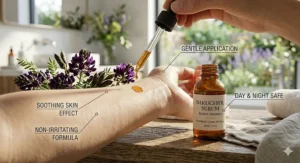
Step 1 — Clean slate. Apply bakuchiol serum to freshly cleansed, dry skin. Residual makeup or SPF creates a film that blocks absorption. Pat dry gently — dragging at your skin defeats the whole purpose of using a gentler active.
Step 2 — The right amount. Two to three drops is enough for the full face and neck. More is not more here; you’re not diluting the active with extra product. You’re just wasting it.
Step 3 — Pat, don’t rub. Use your fingertips to press the serum into the skin in gentle patting motions. This improves absorption without mechanical irritation and is especially important for anyone with sensitive skin.
Step 4 — Layer correctly. Apply bakuchiol before your moisturizer, never after. Thinner textures always go under thicker ones. If you’re using the BYBI booster style, mix two to three drops into your moisturizer in your palm before applying.
Step 5 — Frequency. Unlike retinol — which typically demands a slow introduction of two to three nights per week — most pure bakuchiol serums can be used both morning and night from day one. This is one of bakuchiol’s most underappreciated advantages. Twice-daily use accelerates results compared to a retinol schedule that forces you to ramp up over weeks.
Common mistake to avoid: skipping SPF in the morning. Bakuchiol itself doesn’t increase sun sensitivity, but the collagen-synthesis processes it triggers make fresh, regenerating skin worth protecting from UV damage.
Who Should Actually Switch? Real-World Scenarios
The Pregnant Skincare Enthusiast. You’ve been using retinol for three years. You’re pregnant and your dermatologist just told you to stop. The panic is real. A pure bakuchiol serum — the Beekman 1802 Dream Booster or the BYBI Booster — keeps meaningful anti-aging activity in your routine safely. You will not regress. You will be fine.
The Chronic Retinol Reactor. You’ve tried retinol three times. Every time, your skin flakes, turns red, and looks worse for six weeks before it improves — and by week three you give up. You are not weak-skinned; you may simply be a poor retinol responder. Try the HERBIVORE Regular Strength for 60 days. The absence of peeling alone will feel like a revelation.
The 25-Year-Old Starting Early. Preventative anti-aging is far more effective than corrective anti-aging — every dermatologist agrees on this. If you’re in your mid-twenties and want to start stimulating collagen before visible lines appear, +1HEROLABS gives you all the benefit at a price point that doesn’t require a budget conversation.
The Retinol Veteran Who Wants More. You’ve tolerated retinol fine for years but want to amplify results. Paula’s Choice CLINICAL combines both actives and is formulated specifically for this user. The bakuchiol stabilizes the retinol, extends its half-life in skin, and adds its own collagen-signaling pathway on top of the retinoid mechanism. This is the formulation approach recommended by Dermatology Times for patients seeking maximum photoaging correction.
Bakuchiol vs Retinol Effectiveness: What the Science Actually Says
The comparison between bakuchiol vs retinol effectiveness isn’t a marketing debate — it’s a well-documented clinical story. The landmark 2018 study in the British Journal of Dermatology enrolled 44 volunteers in a randomized, double-blind, 12-week protocol. Half used 0.5% bakuchiol cream twice daily; the other half used 0.5% retinol nightly. Both groups showed significant, statistically comparable improvements in wrinkle surface area and hyperpigmentation. The retinol group reported significantly more stinging and scaling.
Mechanistically, they work differently. Retinol binds to nuclear retinoid receptors (RAR and RXR), directly triggering genetic programs for collagen synthesis. Bakuchiol, as noted on Wikipedia’s bakuchiol entry, is a meroterpene phenol — chemically nothing like a retinoid — yet it upregulates the same collagen genes (COL1, COL3, COL4) and downregulates MMP-1, the enzyme that breaks down existing collagen. Different pathway, same destination.
What bakuchiol cannot yet match is the decades of clinical depth behind retinoids. Prescription tretinoin (retinoic acid) has 50+ years of robust data behind it, and at therapeutic doses, it still outperforms bakuchiol for severe photoaging. But for the majority of people — those seeking gentle anti-aging plant-based skincare without side effects — bakuchiol closes that gap in a meaningful way.
The bottom line: bakuchiol isn’t a consolation prize for people who can’t handle retinol. It’s a legitimate, scientifically validated active that happens to also be kind to your skin.
How to Choose the Right Bakuchiol Serum Retinol Alternative
Walking into a category with dozens of options on Amazon can feel chaotic. Here’s a framework that actually works:
1. Determine your goal. Targeting fine lines just starting to appear? A 0.5% pure bakuchiol serum (HERBIVORE Regular, +1HEROLABS) gets you there. Want maximum anti-aging output and can tolerate retinoids? Paula’s Choice CLINICAL is built for you.
2. Check the concentration. Products should disclose the bakuchiol percentage or ppm. The evidence supports 0.5%–1% as the effective range. Anything below that may provide antioxidant benefits but delivers less meaningful structural change.
3. Look at the supporting cast. Bakuchiol works harder when paired with peptides (collagen signaling), hyaluronic acid (hydration), niacinamide (barrier repair), and vitamin C (brightening + antioxidant protection). An isolated ingredient in a basic carrier does less than a thoughtfully layered formula.
4. Consider your skin type. Dry skin benefits from oil-based formulas like BYBI’s squalane booster. Oily or combination skin tends to do better with water-based or lightweight gel serums.
5. Prioritize pregnancy safety if applicable. If you’re pregnant or breastfeeding, stick to products that explicitly confirm they contain no vitamin A (retinol or retinoids). Beekman 1802 states this plainly.
Features That Actually Matter (And Those That Don’t)
Let’s separate the genuine signals from the marketing noise.
ACTUALLY MATTERS: Disclosed bakuchiol percentage. The spec sheet doesn’t lie — if a brand won’t tell you the concentration, that’s information.
Delivery system. Oil-based bakuchiol absorbs differently from water-based. Neither is inherently better; the question is what suits your skin type and the other products in your routine.
Supporting ingredients. Peptides, niacinamide, hyaluronic acid, and antioxidant vitamins aren’t decoration in a bakuchiol serum — they’re active contributors.
DOESN’T MATTER AS MUCH: The word “organic” on its own. Bakuchiol can be organically sourced and still be poorly formulated.
Price alone. Some of the most effective serums on this list cost under $25. Expensive doesn’t equal better.
“Clean” certifications without ingredient transparency. A product can be certified clean and still be diluted to ineffectiveness. Always read the ingredient list.
A MARKETING CLAIM WORTH BEING SKEPTICAL OF: “Equivalent to prescription tretinoin.” Bakuchiol is excellent. It is not tretinoin. Anyone making that claim is overpromising. A more honest statement — and the one supported by the evidence — is that bakuchiol is comparable to over-the-counter 0.5% retinol in a 12-week clinical setting.
Common Mistakes When Starting a bakuchiol serum retinol alternative
Using it only at night. Unlike retinol, bakuchiol is photostable. It does not degrade in UV light and does not make skin sun-sensitive. Using it only at night means you’re missing an entire round of daily collagen signaling. Use it twice a day.
Expecting retinol-speed results. Bakuchiol is gentler and generally shows visible results in eight to twelve weeks — similar to retinol’s timeline once you account for the weeks retinol users spend recovering from initial irritation. Be patient.
Layering over an active toner without thinking. Stacking bakuchiol over a strong AHA/BHA toner isn’t dangerous, but it can be unnecessarily stimulating for sensitive skin. If you’re new to actives, let bakuchiol be the single active in your routine for the first four weeks.
Forgetting SPF. Bakuchiol doesn’t photosensitize skin, but it actively stimulates new cell turnover. Fresh skin cells are more vulnerable to UV damage. Daily SPF 30+ is non-negotiable for anyone using any anti-aging active, bakuchiol included.
Dismissing it as “less effective” after two weeks. Two weeks is the timeline for side effects, not results. Collagen synthesis is a slow biological process. Commit to at least eight weeks before making any judgment call.
✨ Don’t Miss These Exclusive Deals!
🔍 Tap any product name in this guide to check current prices and availability on Amazon. Your best skin doesn’t need to wait — or break the bank.
Frequently Asked Questions About bakuchiol serum retinol alternative
❓ Is bakuchiol serum really as effective as retinol for reducing wrinkles?
❓ Can I use bakuchiol serum for beginners without any side effects?
❓ Is bakuchiol moisturizer safe for sensitive skin and rosacea-prone skin types?
❓ Can I use a pregnancy-safe retinol substitute like bakuchiol while breastfeeding?
❓ How long does bakuchiol take to show visible results for fine lines and wrinkles?
Conclusion: The Smartest Switch Your Skin Routine Can Make
Here’s the honest summary: bakuchiol isn’t going to replace prescription-grade tretinoin for severe, medical-grade photoaging. But that was never the point. The point is that a significant portion of people who want meaningful anti-aging results have been stopped cold by retinol’s side effects — the peeling, the sensitivity, the months of adjustment that many people simply give up on.
Bakuchiol removes those barriers entirely. It delivers comparable results to over-the-counter retinol in clinical studies. It works in the morning. It’s safe during pregnancy. It doesn’t punish your skin for wanting to age well.
For beginners, the gentle anti-aging plant-based approach of +1HEROLABS or Beekman 1802 is a perfect entry point. For experienced retinol users seeking a cleaner alternative, HERBIVORE Extra Strength or BYBI’s minimalist booster integrates effortlessly. For those who want the absolute ceiling of anti-aging output, Paula’s Choice CLINICAL uses both actives in synergy.
The natural wrinkle reducer conversation has shifted. Bakuchiol isn’t a trend — it’s a proven, science-backed, skin-kind alternative that the research increasingly endorses.
Pick your formula, stick with it for 90 days, and your skin will do the talking.
✨ Don’t Miss These Exclusive Deals!
🔍 Click any product name in this guide to see current pricing on Amazon. These are real products, real formulas, and — if the last 5,000 words haven’t convinced you — real results.
Recommended for You
- Centella Asiatica Acne Scar Healing: 7 Best Products in 2026
- 7 Best Centella Asiatica Cream Sensitive Skin 2026 — Calm & Heal
- 7 Copper Peptide Cream Benefits: Transform Aging Skin 2026
Disclaimer: This article contains affiliate links. As an Amazon Associate, I earn from qualifying purchases. If you purchase products through these links, we may earn a small commission at no additional cost to you.
✨ Found this helpful? Share it with your friends! 💬🤗
