
In This Article
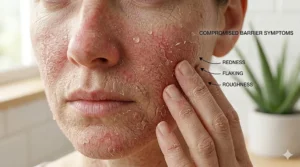
You know that tight, sandpaper-y feeling your face gets after a hot shower? Or the way your skin turns red and raw every time the temperature drops? That’s not just dryness. That’s your skin barrier waving a white flag — and ceramides are what it’s begging for.
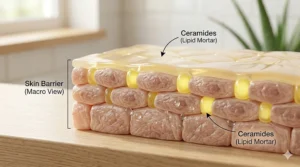
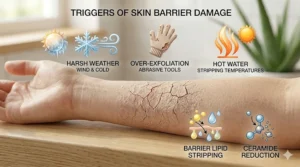
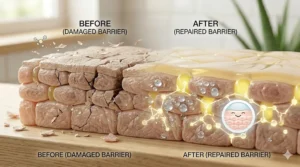
Here’s the thing most people get wrong: they pile on moisturizer after moisturizer without addressing the actual structural problem. Your skin barrier is essentially a brick wall. The “bricks” are skin cells, and the “mortar” holding them together? That’s ceramides — lipid molecules that make up roughly 50% of the outer skin layer. When ceramide levels drop (and they do, thanks to aging, over-exfoliation, harsh weather, and aggressive cleansers), the mortar crumbles. Water escapes through the gaps. Irritants sneak in. Skin becomes reactive, flaky, and chronically uncomfortable.
A ceramide moisturizer for dry skin barrier repair isn’t a luxury — it’s biology. The science backs this up convincingly: a landmark study published in the National Institutes of Health database found that a single application of ceramide-containing moisturizer measurably improved transepidermal water loss (TEWL) and skin hydration for up to 24 hours, with even more significant improvements after 28 days of consistent use. That’s not marketing copy — that’s a randomized controlled trial.
The best ceramide moisturizer dry skin barrier formulas don’t just slap ceramides on the surface. They combine ceramides with cholesterol and fatty acids in ratios that mirror healthy skin’s own lipid composition — the golden triad your stratum corneum recognizes and uses immediately. Pair that with a good humectant like hyaluronic acid, and you’ve got a formula that both patches the wall and fills it with water.
In this guide, I’ve done the heavy lifting. Seven real products, currently available on Amazon, researched and analyzed so you can stop guessing and start healing. Whether you’re dealing with eczema flares, post-retinol sensitivity, or just chronically parched skin that no basic lotion can fix — there’s a pick here for you.
Quick Comparison Table: Top 7 Ceramide Moisturizers at a Glance
| Product | Key Ceramide System | Best For | Price Range | Size |
|---|---|---|---|---|
| CeraVe Moisturizing Cream | 3 ceramides (1, 3, 6-II) + MVE | Budget daily use, body + face | Under $20 | 19 oz |
| COSRX Ceramide Skin Barrier Moisturizer | 7 ceramides + cholesterol + fatty acids | Sensitive, dry, Korean routine lovers | $20–$30 | 2.7 oz |
| AESTURA ATOBARRIER365 Cream | Triple lipid complex + ceramide capsules | Eczema-prone, post-procedure | $25–$40 | 80 mL |
| Skinfix Barrier+ Triple Lipid-Peptide Cream | 3% Triple Lipid + 3% peptides | Aging, dry, barrier-compromised skin | $50–$65 | 1.7–3.3 oz |
| BYOMA Moisturizing Gel Cream | Tri-Ceramide Complex + niacinamide | Oily-to-combo, lightweight preference | $12–$18 | 1.69 oz |
| DERMAdoctor Ceramide Serum Skin Barrier Cream | Ceramide complex + Vitamin C ester | Rosacea, sensitive, antioxidant seekers | $40–$55 | 2.0 oz |
| Dr. Jart+ Ceramidin Skin Barrier Moisturizing Cream | 5-Ceramide Complex | Dry, mature, lipid-starved skin | $40–$55 | 1.35–2.7 oz |
What this table tells you: The spread here is intentional. CeraVe and BYOMA anchor the affordable end — and they genuinely perform. But if you’re dealing with active barrier dysfunction, post-procedure recovery, or mature skin that’s lost significant lipid reserves, the mid-to-premium tier (Skinfix, DERMAdoctor, Dr. Jart+) justifies the price with clinical-grade formulations. The ceramide count alone doesn’t win the race — it’s all about the lipid ratio, delivery system, and supporting ingredients.
💬 Just one click — help others make better buying decisions too! 😊
Top 7 Ceramide Moisturizers for Dry Skin Barrier: Expert Analysis
1. CeraVe Moisturizing Cream — The Unbeatable Workhorse
Some products become classics for a reason. CeraVe Moisturizing Cream has been quietly dominating dermatologist recommendation lists for years, and in 2026, it still hasn’t been knocked off its perch — at least not at its price point.
Key specs that actually matter: The formula contains ceramides 1, 3, and 6-II — the specific types found in healthy human skin. Ceramide 1 in particular is critical for barrier function; studies show it’s often the first to decline in eczema-prone skin. Combined with hyaluronic acid and CeraVe’s proprietary MVE (Multivesicular Emulsion) technology, the cream releases active ingredients gradually over 24 hours. Think of MVE like a slow-drip IV for your skin rather than a one-time flood — it’s why this cream keeps working long after you’ve moved on with your day.
Who is this for? Honestly? Almost everyone who wants a daily driver that won’t bankrupt them. It’s particularly excellent for body use, where you need large amounts without wincing at the cost. People with eczema, psoriasis, or chronically dry arms and legs will get outsized value from the 19 oz tub. The formula is non-comedogenic and fragrance-free, which matters enormously for sensitive skin types.
What most buyers overlook: The texture feels heavy right out of the jar, which makes some people assume it’ll feel greasy. It doesn’t — it absorbs cleanly within a few minutes. The trick is warming a small amount between your palms before applying. Cold cream straight from the tub applies less evenly.
Customers consistently rave about how quickly rough patches on elbows and shins soften, often within a few days. Some wish the jar format were more hygienic; a pump would be nice.
✅ Budget-friendly powerhouse for face and body
✅ MVE technology delivers 24-hour gradual hydration
✅ National Eczema Association Seal of Acceptance
❌ Jar packaging can feel unhygienic over time
❌ Heavier texture may feel too rich for humid climates
Under $20 for 19 oz — exceptional value for daily whole-body ceramide repair.
2. COSRX Ceramide Skin Barrier Moisturizer — Seven Ceramides, Zero Compromise
Where CeraVe plays the everyman, COSRX is speaking directly to the skincare-educated crowd. Seven ceramides. That’s not a marketing flex — it reflects a growing understanding that different ceramide types serve different barrier functions, and stacking them creates more comprehensive lipid restoration.
Key specs that actually matter: The formula delivers 1.5% ceramide concentration alongside 0.5% cholesterol and 1.5% fatty acids. That ceramide-to-cholesterol-to-fatty-acid ratio — roughly 3:1:3 — closely mimics the natural lipid composition of a healthy stratum corneum. It’s not random; this ratio is what dermatology researchers have identified as optimal for barrier restoration. The “Korean Gliding Texture” creates a smooth, almost silky finish that primes the skin beautifully under makeup — so this isn’t just a night-cream hiding in your drawer.
Who is this for? The skincare enthusiast who knows their ceramide NP from their ceramide EOP and wants a formula that doesn’t cut corners. It’s also brilliant for anyone whose skin barrier took a beating from acids, retinoids, or aggressive exfoliation — that post-peel rawness melts away noticeably. Dry and sensitive types will appreciate the comprehensive lipid replenishment without heaviness.
What most buyers overlook: Korean skincare formulas often look expensive per ounce at first glance. At 2.7 oz in the $20–$30 range, the COSRX seems pricier than CeraVe until you realize a little goes an exceptionally long way — it’s a face cream, not a body lotion.
Customers love the lightweight-yet-rich paradox this cream achieves; many note visible improvement in skin suppleness within 2–3 days. A few with very oily skin find it sits slightly heavy in summer.
✅ 7-ceramide blend with skin-identical lipid ratios
✅ Dual-function: barrier repair + makeup primer
✅ Tested for sensitive skin; no fragrance, no harmful additives
❌ Premium cost-per-ounce compared to drugstore options
May feel too rich for oily skin in warm weather
In the $20–$30 range — a smart investment for serious barrier rebuilding on the face.
3. AESTURA ATOBARRIER365 Cream — The Eczema Whisperer from Korea
A product selling at a rate of one every 7 seconds in its home country isn’t hype — it’s proof of concept. AESTURA ATOBARRIER365 Cream has built a cult following among people with clinically compromised barriers, and for good reason: it approaches ceramide delivery differently from almost anything else on the market.
Key specs that actually matter: The patented ceramide capsule technology is the standout here. Instead of ceramides floating freely in the formula (where they can degrade or fail to penetrate effectively), they’re encapsulated — tiny spheres that burst on contact with skin and deliver a concentrated payload exactly where the barrier is weakest. The surrounding formula adds squalane and Vitamin E for occlusive protection and antioxidant defense. The result is 120 hours of claimed sustained hydration — and while I’d always recommend reapplication long before that, the baseline moisture retention between applications is genuinely impressive.
Who is this for? This is the cream I’d put in the hands of anyone dealing with active eczema, highly reactive skin, or post-procedure recovery (it’s been clinically studied after microneedling). The National Eczema Association’s Seal of Acceptance isn’t handed out lightly — it means the formula has passed a rigorous review for safety and efficacy on compromised skin. Parents dealing with children who have atopic dermatitis often discover this as a gentler alternative to prescription-only options.
Customers highlight how quickly redness and tightness subside after application. Some note the texture is slightly thicker than expected for a “gel” formula, which is actually a feature when your barrier is severely depleted.
✅ Patented ceramide capsule delivery system for targeted repair
✅ NEA Seal of Acceptance; ideal for eczema-prone skin
✅ Clinically validated post-microneedling skin recovery
❌ Thicker consistency may not suit warm-weather or oily skin
❌ Smaller jar size (80mL) for the price compared to drugstore options
In the $25–$40 range — justified for chronic barrier issues where cheaper options haven’t worked.
4. Skinfix Barrier+ Triple Lipid-Peptide Cream — Where Clinical Meets Premium
This one comes with receipts. Skinfix had 100% of clinical trial participants show immediate barrier function improvement after first use — a number that sounds impossible until you look at what’s inside.
Key specs that actually matter: The 3% Triple Lipid Complex (ceramides NP, AP, and EOP + cholesterol + fatty acids) is paired with a 3% Peptide Solution — and that combination is what separates this from other ceramide creams. Ceramides rebuild the structure; peptides support the skin’s own regenerative signaling. The 8% humectant blend (hyaluronic acid, glycerin, red algae) then fills that rebuilt structure with water. Four weeks of use in clinical testing showed skin that was 26% glowier, 29% smoother, and 12% firmer. These aren’t vanity metrics — firmness reflects genuine barrier integrity improvement.
Who is this for? Mature skin that has lost significant lipid reserves, skin recovering from active eczema or rosacea flares, and anyone who’s been a heavy retinoid user and needs structural support rather than surface hydration. This is also the cream for the person who tried CeraVe and found it helpful but not quite enough — Skinfix is what happens when you turn the dial up to clinical-grade. Fragrance-free, non-comedogenic, vegan, cruelty-free.
Customers who switched from luxury department-store creams are consistently surprised to find this performs better for barrier issues. The only common complaint is price — fair, but the refillable jar option helps offset it.
✅ Clinically proven: 100% of users showed immediate barrier improvement
✅ Triple Lipid + Peptide combination addresses structure AND renewal
✅ Refillable packaging available (eco-conscious bonus)
❌ Premium price point may not suit budget shoppers
❌ Rich texture may be too heavy for combination skin types
In the $50–$65 range — premium pricing, but clinical evidence makes it defensible.
5. BYOMA Moisturizing Gel Cream — The Ceramide Revolution for Oily Skin
Let’s address the elephant in the room: most ceramide creams feel like they were designed for someone living in the Sahara. BYOMA solved that problem.
Key specs that actually matter: The Tri-Ceramide Complex (ceramide NP + cholesterol + fatty acids) is delivered in an oil-free, alcohol-free gel-cream base — meaning the barrier-rebuilding lipids are there, but the heavy, occlusive texture is not. Niacinamide adds pore-minimizing and anti-inflammatory benefits that synergize beautifully with ceramide repair. Green tea extract brings antioxidant support. The result absorbs in seconds, leaves zero white cast or greasiness, and works beautifully as a lightweight moisturizer in humid climates or for anyone with oily-to-combination skin who previously thought ceramide creams weren’t for them.
Who is this for? Oily and combination skin types who’ve been skipping ceramide repair because every product felt like a face full of vaseline. Younger skin that wants barrier maintenance without looking shiny. Hot-climate users. Anyone layering under SPF who needs something that doesn’t pill or feel suffocating. At under $18 for 1.69 oz, it’s also the best entry-level ceramide product for teenagers or skincare newcomers who want something evidence-based without the price tag.
Customers love the immediate brightening effect from niacinamide and consistently report that it layers perfectly under sunscreen. Some note they’d prefer a larger size for the price.
✅ Oil-free gel-cream delivers ceramides without heaviness
✅ Niacinamide + ceramides = dual barrier + pore action
✅ Best budget ceramide option for oily/combo skin
❌ Small 1.69 oz size runs out quickly for full-face use
❌ Lighter formula may not be enough for severely dry or eczema skin
Under $18 — the best budget ceramide pick for warm climates and oily skin types.
6. DERMAdoctor Ceramide Serum Skin Barrier Cream — The Antioxidant-Ceramide Crossover
Most ceramide creams are purely defensive — they patch and protect. DERMAdoctor had a different idea: what if barrier repair and antioxidant therapy happened at the same time?
Key specs that actually matter: The formula combines a ceramide complex with Vitamin C Ester, Vitamin E, and ferulic acid. That trio is famous in cosmetic chemistry for a reason — Vitamin C Ester is more stable than ascorbic acid and gentler on sensitive skin, while ferulic acid doubles the photoprotective activity of vitamins C and E synergistically. This means you’re repairing the barrier and defending against the environmental oxidative stress that caused the damage in the first place. The cream is hypoallergenic, fragrance-free, non-comedogenic, and clinically tested — not just for efficacy, but specifically for sensitive and rosacea-prone skin.
Who is this for? People dealing with rosacea or reactive skin who also want to address uneven tone and early signs of aging — without layering a separate vitamin C serum on top of an already-compromised barrier (which can sting and inflame). Dermatologist-formulated products carry weight here; the DERMAdoctor brand has a strong clinical pedigree. If you’re tired of your morning antioxidant serum burning on sensitized skin, this is the workaround.
Customers note visible calming of redness and, over time, a more even complexion. A small number with very reactive skin report a mild initial tingling — patch testing is always wise.
✅ Unique ceramide + Vitamin C Ester + ferulic acid combination
✅ Specifically formulated for rosacea and eczema-prone skin
✅ Fragrance-free, hypoallergenic, non-comedogenic
❌ Vitamin C component may cause initial sensitivity for some
❌ Higher price for a relatively small 2.0 oz jar
In the $40–$55 range — ideal for those who want barrier repair and brightening in one step.
7. Dr. Jart+ Ceramidin Skin Barrier Moisturizing Cream — Five Ceramides for Lipid-Starved Skin
Dr. Jart+ built its reputation on one concept: bridge the gap between dermatology and cosmetics. Ceramidin is perhaps the purest expression of that philosophy.
Key specs that actually matter: The 5-Ceramide Complex targets dry, dull, compromised skin with a multi-pronged lipid approach — covering ceramide types that address different layers and functions of barrier recovery. Critically, the formula also targets visible anti-aging markers: pore appearance, firmness, and radiance. This makes it unusual among pure barrier-repair creams — it doesn’t just stop at “less dry.” The texture is rich but not heavy, sitting at that perfect Goldilocks consistency that feels luxurious without suffocating.
Who is this for? Dry and mature skin types who want their barrier cream to double as an anti-aging moisturizer. People in their 30s and 40s who notice their skin is simultaneously more sensitive and more lined than it used to be — that’s ceramide depletion at work, and this formula addresses both symptoms. It’s also a favorite for anyone with very dry, lipid-starved skin who finds lighter formulas evaporate before they’ve had a chance to sink in.
Customers consistently praise the creamy, indulgent texture and note visible plumping and radiance improvement within one to two weeks. Some find the price hard to justify for everyday use and reserve it for nighttime application.
✅ 5-ceramide complex for comprehensive lipid restoration
✅ Anti-aging benefits alongside barrier repair
✅ Rich, indulgent texture ideal for very dry and mature skin
❌ Higher price point difficult to justify for budget shoppers
❌ Rich texture may clog pores for acne-prone skin types
In the $40–$55 range — a top pick for dry, mature, or lipid-starved skin seeking barrier repair with anti-aging perks.
✨ Don’t Miss These Exclusive Deals!
🔍 Ready to Give Your Skin Barrier the Ceramides It’s Been Crying Out For?
Click any highlighted product above to check current pricing and availability on Amazon. These aren’t just moisturizers — they’re barrier-rebuilding tools your skin will thank you for. Don’t wait for another flare-up to take your skin health seriously.
How to Apply a Ceramide Moisturizer Correctly: A Practical Usage Guide
Getting the right product is half the battle. Using it correctly is the other half — and this is where most people leave results on the table.
Step 1: Cleanse Without Stripping
Start with a gentle, sulfate-free cleanser. Harsh foaming cleansers strip the very lipids you’re trying to replenish. If your cleanser leaves your face feeling “squeaky clean,” it’s likely doing barrier damage that your ceramide cream then has to undo.
Step 2: Apply on Damp Skin
This is the most underrated application tip. Apply your ceramide cream while skin is still slightly damp — not dripping wet, but not fully dry. Ceramides are lipid-based; they work best when there’s surface moisture to seal in. On fully dry skin, they’re playing catch-up.
Step 3: Use Enough Product
A pea-sized amount is almost always insufficient for full facial coverage. Use a nickel-sized amount and warm it between your fingertips before pressing it gently into skin — pressing rather than rubbing minimizes friction on an already-irritated barrier.
Step 4: Layer Strategically
If you’re using serums (hyaluronic acid, niacinamide), apply them before your ceramide cream. The ceramide cream acts as the last sealing layer — the occlusive “lid” that traps everything underneath. Applying ceramide cream before a water-based serum defeats its own purpose.
Step 5: Commit for 28 Days
Clinical research on ceramide moisturizers consistently shows that meaningful barrier improvement requires a full 28-day commitment with twice-daily application. One week won’t reveal the full picture. Mark your calendar, stick with it, and expect the first visible improvements (softness, reduced tightness) around day 7–10.
Common Mistakes to Avoid in the First 30 Days
- Mixing with active exfoliants too soon: Let your barrier stabilize for 2–4 weeks before reintroducing acids or retinoids.
- Skipping SPF after morning application: A repaired barrier is still vulnerable to UV damage that breaks down ceramides.
- Expecting instant “glow”: Barrier repair is structural — it’s not the same as a brightening serum. Give it time.
Who Should Use Which Ceramide Cream? Real-World Scenarios
The Post-Retinoid Reactor
You started tretinoin three months ago. Your skin is smoother in texture but perpetually raw, flaky, and sensitive to almost everything. What you need is Skinfix Barrier+ Triple Lipid-Peptide Cream — the clinical lipid ratio combined with peptides supports your skin’s own repair while the retinoid does its job. Apply a generous amount every evening after the tretinoin has fully absorbed (20–30 minutes). You’ll notice significantly less morning flakiness within a week.
The Chronic Eczema Sufferer
Your skin cycles through flares unpredictably — triggered by stress, weather changes, or nothing identifiable at all. AESTURA ATOBARRIER365 is built for you. The patented capsule delivery ensures ceramides reach the barrier precisely when and where it’s weakest. Combine with CeraVe Moisturizing Cream on body areas for a cost-effective two-product system that covers face and body without breaking the budget.
The 40-Something Whose Skin “Changed Overnight”
Ceramide production declines with age — significantly. If your skin used to be oily and suddenly feels dry, tight, and thin, that’s lipid depletion at work. Dr. Jart+ Ceramidin’s 5-ceramide complex and anti-aging benefits make it the most logical daily driver, with COSRX Ceramide Skin Barrier Moisturizer as an excellent alternative that delivers the key ceramide-cholesterol-fatty acid triad at a slightly lower price.
The Oily-Skin Skeptic
You’ve avoided moisturizer for years because everything made you break out. BYOMA Moisturizing Gel Cream was designed with you specifically in mind. Oil-free, lightweight, with niacinamide to manage sebum and green tea to calm inflammation — it rebuilds your barrier without triggering congestion. Start with a small amount every other night, then build to twice daily as your skin adjusts.
The Science Behind Ceramide Complex Benefits (What the Label Won’t Tell You)
Understanding why ceramides work makes you a smarter shopper. Here’s the condensed version.
The Lipid Barrier Trinity
Ceramides don’t work in isolation. Your skin barrier’s intercellular “mortar” is a precise mixture of ceramides (~50%), cholesterol (~25%), and fatty acids (~15%). When any one of these is missing, the mixture doesn’t perform correctly — it’s like trying to make concrete without the right sand-to-cement ratio. This is why formulas that include all three (look for “triple lipid complex” language on labels) outperform single-ceramide products on compromised skin.
Research published in PubMed found that a ceramide-dominant physiological lipid moisturizing cream significantly improved transepidermal water loss and skin hydration in eczema patients compared to placebo — while the placebo group’s barrier function either stayed flat or worsened over the same period. This is the kind of data that separates ceramide science from marketing spin.
Ceramide Types: A Quick Decoder
Not all ceramides are equal. Here’s what those cryptic names mean for your skin:
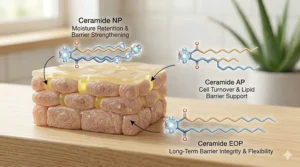
- Ceramide NP (Ceramide 2): The most abundant naturally; critical for water-binding in the upper skin layers
- Ceramide AP (Ceramide 6-II): Supports overall barrier cohesion; often depleted in dry and eczema skin
- Ceramide EOP (Ceramide 1): The “linker” ceramide that connects the barrier’s protein envelope to the lipid layers — its depletion is strongly associated with eczema severity
Products containing all three types — NP, AP, and EOP — are providing the most comprehensive lipid supplementation. You’ll find all three in Skinfix Barrier+ and several others on this list.
Lipid Barrier Restoration vs. Surface Hydration
Here’s the distinction that changes everything: most basic moisturizers add water to the skin’s surface. Ceramide moisturizers rebuild the barrier that holds water in. It’s the difference between filling a cracked bucket and actually fixing the crack. Humectants (hyaluronic acid, glycerin) fill the bucket. Ceramides fix it. You need both — but without barrier repair, no amount of hyaluronic acid serum will keep your skin hydrated for long.
According to the American Academy of Dermatology, people with dry skin and eczema benefit most from creams and ointments (rather than lotions) because they contain more lipid-replenishing ingredients — ceramide creams sit squarely in this recommended category.
Ceramide Repair Cream vs. Regular Moisturizer: The Real Difference
| Feature | Regular Moisturizer | Ceramide Repair Cream |
|---|---|---|
| Primary action | Surface hydration | Structural barrier repair |
| Duration of effect | Hours | Days to weeks (cumulative) |
| Mechanism | Humectants attract water | Lipids restore barrier mortar |
| Suitable for eczema? | Temporary relief only | Yes — addresses root cause |
| Works with actives (retinol, acids)? | Passive support | Active protection for barrier |
| Long-term skin improvement | Minimal | Significant with consistent use |
Reading this data: Regular moisturizers aren’t bad — they’re just working on a different layer. If your skin is chronically dry, tight, or reactive despite using moisturizer daily, you’re dealing with a structural barrier problem that surface humectants can’t solve. A ceramide repair cream addresses the root cause. The investment in a proper ceramide formula pays off exponentially over time — less sensitivity, fewer reactions to actives, more resilient skin overall.
How to Choose a Ceramide Moisturizer: What Actually Matters
Shopping for ceramide moisturizer dry skin barrier products can feel overwhelming with hundreds of options available. Here’s how to cut through the noise:
1. Check for the Lipid Triad
Look for ceramides + cholesterol + fatty acids together. Any formula missing one of the three delivers incomplete barrier support.
2. Look for Multiple Ceramide Types
Formulas listing ceramide NP, AP, and EOP provide the most clinically relevant coverage for dry and eczema-prone skin.
3. Prioritize Fragrance-Free Formulas
This is non-negotiable for compromised barriers. Fragrance — even “natural” fragrance — is a common barrier irritant that can perpetuate the cycle you’re trying to break.
4. Match Texture to Climate and Skin Type
Rich creams (Dr. Jart+ Ceramidin, Skinfix) for dry climates and very dry skin. Gel-creams (BYOMA) for humid climates and oily-to-combo skin. Medium-weight creams (COSRX, AESTURA) work well in most conditions.
5. Consider Certifications
National Eczema Association Seal of Acceptance, dermatologist-tested claims, and clinical study data are meaningful signals. “Dermatologist-approved” without specifics is marketing.
6. Don’t Ignore Concentration
“Contains ceramides” means nothing if they’re the last item on a 30-ingredient list. Look for products where ceramides appear in the first half of the ingredient list, or where concentrations are disclosed (like COSRX’s 1.5% ceramide).
7. Factor in Your Actives Routine
If you’re using retinoids or acids regularly, prioritize formulas with higher lipid concentrations and peptide support (Skinfix Barrier+). For ceramide-only maintenance without actives, the mid-range options work beautifully.
Common Mistakes When Buying a Ceramide Moisturizer for Dry Skin
Mistake #1: Judging by Texture Alone
A heavier cream doesn’t automatically mean more ceramide content. BYOMA’s lightweight gel contains a full ceramide-cholesterol-fatty acid complex despite feeling almost weightless. Always read the ingredient list, not just the texture.
Mistake #2: Buying the Cheapest Option and Expecting the Best Results
Budget matters, and CeraVe genuinely works. But if you’ve been using drugstore ceramide creams for months with minimal improvement, the issue may be concentration and lipid ratio — not the concept itself. Upgrading to a clinical-grade formula like Skinfix or AESTURA may be the turning point.
Mistake #3: Treating It Like a Serum (Too Little Product)
Ceramide creams need generous application to form a meaningful barrier layer. Applying a thin sheen and calling it done is like putting one coat of paint on a crumbling wall. Use enough that your skin feels genuinely coated, then let it absorb.
Mistake #4: Quitting After One Week
A compromised skin barrier took months (or years) to develop. Meaningful structural repair requires consistent daily use for at least 28 days. Week one results are preliminary; judge at the four-week mark.
Mistake #5: Layering Incompatible Products
Applying a ceramide cream immediately before a retinoid can buffer the retinoid too much, reducing its efficacy. Conversely, applying retinoid immediately before the ceramide cream on compromised skin can cause significant irritation. The right sequence: cleanse → water-based actives → ceramide cream (as the final sealing layer in PM routines).
Long-Term Skin Barrier Maintenance: The ROI of Ceramide Skincare
Here’s the financial and physical math that most people don’t run: a consistently maintained skin barrier means fewer reactive episodes, less money spent on calming treatments, fewer dermatologist visits for eczema management, and the ability to tolerate more powerful actives (retinoids, chemical exfoliants) without destroying your skin.
A $50 jar of Skinfix Barrier+ Triple Lipid-Peptide Cream lasting two months costs less than a single urgent-care visit for a severe eczema flare. CeraVe at under $20 for a tub that lasts a full month on face and body is cheaper than most prescription hydrocortisone creams, and it addresses the structural cause rather than just suppressing the symptoms.
Think of ceramide moisturizer dry skin barrier maintenance the same way you think about dental care: neglect it and the repairs are expensive. Maintain it consistently and you’re investing pennies per day in outcomes that compound over years. The NIH research on ceramide supplementation in eczema patients confirms that regular use translates to measurably improved quality of life scores — not just better-looking skin, but genuinely more comfortable daily living.
Over time, a well-maintained barrier also means:
- Better tolerance for actives: Stronger barriers withstand retinoids and acids more easily
- Less reactive skin overall: Fewer environmental triggers cause flares
- More even skin tone: Reduced chronic inflammation means less post-inflammatory hyperpigmentation
- Lower long-term skincare spend: Less crisis management, more maintenance
FAQ: Ceramide Moisturizer for Dry Skin Barrier
❓ What makes the best ceramide moisturizer for dry skin barrier repair different from regular moisturizer?
❓ Can ceramide repair cream eczema flares effectively?
❓ How long until I see results from a triple ceramide treatment?
❓ Is the best ceramide serum barrier repair better than a ceramide cream?
❓ Are ceramide complex benefits the same for all skin types, including oily skin?
Conclusion: Your Skin Barrier Deserves Better Than Basic Lotion
Your skin works hard. Every day it’s fending off UV radiation, pollution, temperature swings, harsh products, and the simple fact of getting older — all of which steadily erode the ceramide-rich barrier that keeps it intact. Slapping on a basic moisturizer is like putting a Band-Aid on a cracked foundation. It covers the surface, but it doesn’t fix the structure.
The ceramide moisturizer dry skin barrier picks in this guide are doing real biological work. CeraVe covers the everyday budget-friendly base. COSRX and AESTURA bring Korean skincare’s meticulous formulation philosophy to serious barrier rebuilding. Skinfix delivers clinical-grade lipid + peptide therapy. BYOMA makes ceramide repair accessible to oily skin. DERMAdoctor and Dr. Jart+ round out the premium tier with antioxidant enrichment and multi-ceramide luxury, respectively.
Pick one that matches your skin type, budget, and current barrier status. Commit to 28 days. Apply correctly — on damp skin, generously, as the last step before SPF. Don’t expect miracles at day three. Expect them at day 28.
Your skin will feel the difference. Soon, you’ll wonder what you were doing before.
✨ Don’t Miss These Exclusive Deals!
🔍 Ready to Transform Your Skin Barrier?
Click any highlighted product above to check current prices and availability on Amazon. Healthier, calmer, more resilient skin is one well-formulated ceramide cream away — don’t let another winter or another retinoid cycle wreck what you’re working to build!
Recommended for You 📖
- 7 Best Pregnancy Safe Retinol Substitutes – Glowing Skin in 2026
- 7 Best Bakuchiol Serum Retinol Alternatives That Actually Work (2026)
- Centella Asiatica Acne Scar Healing: 7 Best Products in 2026
Disclaimer: This article contains affiliate links. As an Amazon Associate, I earn from qualifying purchases. If you purchase products through these links, we may earn a small commission at no additional cost to you.
✨ Found this helpful? Share it with your friends! 💬🤗
