
In This Article
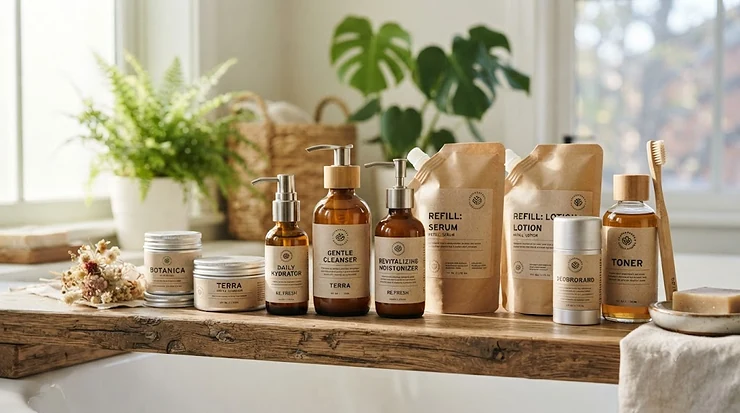
Your bathroom cabinet is basically a tiny landfill waiting to happen. Every cleanser tub, serum bottle, and moisturizer jar you toss this year joins roughly 35.7 million tons of plastic Americans throw out annually, and a huge chunk of that comes from containers and packaging alone. That’s the unglamorous math behind the sudden explosion of eco-friendly refill skincare brands — companies that let you keep the outer vessel (glass, aluminum, or a sturdy compact) and simply swap in new product instead of pitching the whole thing.
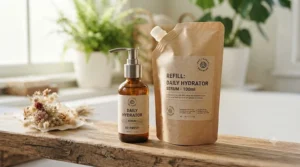
what is refill skincare, exactly? It’s a packaging model where you buy a durable primary container once, then purchase lighter, lower-plastic refills — pouches, cartridges, or bulk pours — to replenish it, cutting single-use packaging waste dramatically compared to buying a brand-new bottle every time.
This isn’t just a feel-good marketing angle, either. It’s becoming the backbone of how thoughtful brands build a genuinely sustainable refillable beauty routine. Some companies, like the pioneers you’ll meet below, have gone 100% refillable. Others, including legacy department-store names, have quietly rolled refill pouches into a handful of hero products. The results vary wildly in real-world performance, price, and how much plastic they truly eliminate — which is exactly what we’re digging into here.
Below, you’ll find seven real, currently available refill skincare brands spanning budget, mid-range, and luxury price points, plus the practical stuff nobody tells you: how a refillable moisturizer jar system actually works day to day, what mistakes trip up first-timers, and whether any of this saves you money long-term. We pulled specs and aggregated review sentiment from brand sites, retailers, and sustainability-focused publications, so you’re getting analysis grounded in what’s actually documented — not guesswork dressed up as expertise.
Quick Comparison Table
| Brand | Refill Format | Price Range | Best For |
|---|---|---|---|
| Activist Skincare | Lightweight refill pouch | Around $50 (trial kit) | 100% refillable full routine |
| Plaine Products | Return-and-reuse aluminum bottle | Under $30 | Budget-friendly body & face basics |
| Kjaer Weis | Refillable metal compact | $60-$100+ range | Luxury minimalist skincare |
| Kiehl’s | In-store/online refill pouch | $30-$70 range | Widely available mid-range refills |
| La Mer | Refillable jar (select lines) | $300+ range | Ultra-premium, marine-based formulas |
| Meow Meow Tweet | Refillable glass/metal jar | $20-$40 range | Small-batch, plastic-free basics |
| OneSkin | Reusable outer + refill cartridge | $50-$90 range | Peptide-based anti-aging refills |
Looking across the table, the split is less about which brand is “greenest” on paper and more about how committed each one is to the refill system as the default, not the exception. Activist Skincare and Plaine Products were built refill-first from day one, while Kiehl’s and La Mer retrofitted refill pouches onto legacy product lines that still sell plenty of standalone bottles too. Budget-conscious shoppers land with Plaine Products or Meow Meow Tweet, while anyone chasing clinical-grade actives in a refillable format should look toward OneSkin or Kjaer Weis.
💬 Already have a favorite on this list? Tap through to check current pricing and availability before it changes.
💬 Just one click — help other golfers find the right club for their game too!😊
Top 7 Eco-Friendly Refill Skincare Brands: Expert Analysis
1. Activist Skincare — the closest thing to a fully refillable routine
Activist Skincare built its entire business model around one idea: keep the bottle, refill the formula. The standout feature here is that nearly the whole line — cleansing balm, vitamin C serum, calming serum, and facial oil — ships in reusable bottles paired with refill pouches you pour in yourself.
Specs-wise, the brand says its pouch system cuts plastic use in the sprayers, droppers, lids, and pumps by more than 80%, since those pieces stay with you instead of getting binned every reorder. On paper, that’s a meaningfully bigger dent in packaging waste than a brand that only refills the jar but replaces the pump each time. The formulas also lean on clinically-referenced actives like vitamin C, niacinamide, and coenzyme Q10, which matters because “natural” and “effective” don’t always overlap in clean beauty.
Based on aggregated customer sentiment across retailer and brand-site reviews, users consistently praise the cleansing balm’s gel-to-oil texture and the facial oil for sensitive, mature skin, though a recurring critique is that the Vitamin C serum feels underwhelming compared to dedicated Vitamin C-only formulas. What most buyers overlook is that the refill pouches cost only about 10-15% less than the original bottle — not the dramatic discount some expect from “just” refilling.
Pros:
- ✅ Genuinely 100% refillable across the whole routine
- ✅ Reduces non-recyclable pump/dropper waste by over 80%
- ✅ Donates a share of revenue to people and planet causes
Cons:
- ❌ Refill pouches aren’t dramatically cheaper than full bottles
- ❌ Vitamin C serum gets mixed aggregated review feedback
At the time of research, the trial kit sits around the $50 mark, positioning Activist Skincare as a reasonable mid-range entry point if you want to test a full refillable routine before committing to full-size bottles.
2. Plaine Products — most budget-friendly return-and-reuse system
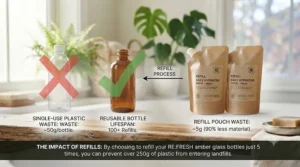
Plaine Products takes a refill-and-return approach that’s refreshingly low-tech: aluminum bottles you keep, plus a mailer to send the empties back for professional cleaning and reuse, rather than recycling them yourself.
The face moisturizer and body lotion both ship in infinitely recyclable aluminum, and the brand states its formulas are sulfate-, paraben-, phthalate-, and palm-oil-free. In practice, aluminum’s advantage over plastic is that it can be recycled indefinitely without degrading in quality, whereas plastic degrades with each recycling pass — a detail that rarely makes it onto a product label but matters if you actually care where your container ends up.
Honest analysis here: this is a solid pick for anyone who wants low-friction sustainability without overhauling their whole medicine cabinet, but it’s not chasing cutting-edge actives. Aggregated reviewer sentiment consistently highlights the lightweight, non-greasy finish and gentle formulation for sensitive and kid-safe use, with the aloe-and-shea base drawing repeat praise. A common thread in reviews is appreciation for the free return-and-refill mailer process, which removes the guesswork of “is this actually getting reused.”
Pros:
- ✅ Return-and-reuse aluminum system, not just recyclable
- ✅ Sulfate, paraben, and phthalate-free formulas
- ✅ Certified cruelty-free and majority women-owned
Cons:
- ❌ Formulas skew basic rather than treatment-focused
- ❌ Limited to a narrower product range than bigger brands
Price-wise, Plaine Products typically lands in the affordable $15-$30 range per item, making it the easiest low-cost entry into a plastic-free beauty routine on this list.
3. Kjaer Weis — the luxury refillable moisturizer jar system
Kjaer Weis approaches sustainability from the design side: sleek, refillable metal compacts meant to be kept for years, not tossed after one use-up.
The brand sources ingredients from certified organic farms and houses its skincare in metal cases engineered specifically as a long-term refillable moisturizer jar system rather than a single-use vessel with a refill bolted on. What that means in practice is the upfront cost buys durability — these compacts are built to survive years of refills, so the real savings show up two or three cycles in, not on the first purchase.
Based on the spec comparison with mass-market refill programs, Kjaer Weis sits closer to fine jewelry than drugstore skincare in build quality, and the brand’s Scandinavian minimalist design philosophy is clearly aimed at people who want their vanity to look intentional, not cluttered. Reviewers in the clean-beauty space consistently frame this as a “buy once, refill forever” investment piece rather than an everyday commodity purchase.
Pros:
- ✅ Refillable metal compacts designed to last for years
- ✅ Certified organic ingredient sourcing
- ✅ High resale/collectible aesthetic value
Cons:
- ❌ Premium pricing puts it out of reach for casual shoppers
- ❌ Smaller shade/formula range than mass-market lines
At the time of research, expect a $60-$100+ range depending on the specific compact and refill combination — steep, but the case is designed to outlive several refill cycles.
4. Kiehl’s Ultra Facial Cream — most accessible refill pouch at retail
Kiehl’s proves a 19th-century apothecary brand can still modernize: select hero products, including the Ultra Facial Cream and Calendula Toner, now come with refill pouches available both online and in-store.
The brand states its refill pouches reduce plastic use by up to 80% versus buying a brand-new jar each time, since you’re only replacing the lightweight pouch, not the sturdier outer jar. What most shoppers overlook is that Kiehl’s also runs a long-standing “Recycle and Be Rewarded” take-back program, letting you return empty containers for samples — a second sustainability lever most refill-only brands don’t offer at all.
Here’s what to weigh: because Kiehl’s is a mass-retail brand with counters in most malls, this is by far the easiest refill system to actually maintain long-term, since you’re not waiting on a niche online reorder. The Ultra Facial Cream in particular draws consistent aggregated praise for its water-based, oil-free hydration that works across skin types, including oily and combination skin that often reacts poorly to heavier creams.
Pros:
- ✅ Refill pouches cut plastic use by up to 80%
- ✅ Available in-store nationwide, not just online
- ✅ Additional take-back program for empty containers
Cons:
- ❌ Only select products offer the refill option
- ❌ Refill pouches still generate some packaging waste
Pricing typically runs in the $30-$70 range depending on jar size, with refill pouches priced somewhat below a brand-new jar of the same size.
5. La Mer — ultra-premium refillable jar with marine-based formulas
La Mer sits at the top of the price ladder, but it’s worth including because its refillable packaging push is backed by real scale: the brand states more than 75% of its packaging is recycled, recyclable, reusable, refillable, or recoverable.
The signature Miracle Broth ferments sea kelp and nutrients into a texture-rich moisturizer, and La Mer has been transitioning key products into refillable jar formats alongside partnerships with ocean conservation NGOs through its Blue Heart Oceans Fund. What that combination means in practice: you’re paying largely for the brand’s marine-sourcing story and legacy prestige, with the refill system functioning as a genuine but secondary sustainability layer.
Honest take — this isn’t the pick for someone shopping primarily on eco-credentials per dollar; it’s for someone already loyal to the formula who’s relieved a refillable option now exists. Aggregated reviewer sentiment on the Miracle Broth-based creams consistently centers on the rich, cushiony texture and visible plumping effect, though price sensitivity is the most common complaint across long-time users.
Pros:
- ✅ Over 75% of packaging is now recycled or refillable
- ✅ Backed by an active ocean conservation fund
- ✅ Legacy formula with decades of brand reputation
Cons:
- ❌ Among the most expensive options on this list by far
- ❌ Refill availability is limited to select product lines
At the time of research, La Mer’s core moisturizers sit in the $300+ range, squarely positioning it as a luxury purchase rather than a daily-driver refill habit.
6. Meow Meow Tweet — small-batch, plastic-free beauty on a budget
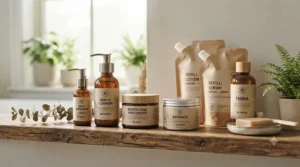
Meow Meow Tweet makes its case with small-batch production and a genuinely plastic-free beauty ethos: face cleanser, toner, and cream ship in refillable metal or glass jars, many doubling as multi-purpose products.
The brand’s take-back program lets customers return empty bulk containers and pumps for reuse and recycling, and production runs are tracked for weekly waste — a level of transparency that’s rare even among “sustainable” brands. What most buyers overlook about this model is the multi-use design: the face cleanser reportedly also works as a shaving cream, and the skin cream doubles as a night cream, cleansing balm, and makeup remover, effectively shrinking your bathroom shelf and your packaging footprint at once.
Reviewers consistently note the brand’s playful packaging and multi-functional formulas as standout traits, with certified cruelty-free status (Leaping Bunny) reinforcing trust for ethically-minded shoppers. If you’re the type who resents owning six single-purpose products, this brand’s whole philosophy is built around you.
Pros:
- ✅ Multi-purpose formulas reduce total product count
- ✅ Take-back program for bulk containers and pumps
- ✅ Small-batch production with tracked weekly waste
Cons:
- ❌ Playful branding may feel less “clinical” to some buyers
- ❌ Smaller company means slower restocks at times
Budget-wise, most items land in the accessible $20-$40 range, making this one of the more wallet-friendly entries for anyone building out sustainable refillable beauty basics.
7. OneSkin — refillable cartridge system for peptide-based anti-aging
OneSkin stands out as the science-forward pick: founded by doctors and scientists, the brand centers its line around the OS-01 peptide, which the company says is the first ingredient scientifically studied for reversing skin’s biological age markers.
Rather than a bottle-and-pour refill, OneSkin uses reusable outer packaging paired with single-use cartridges that the brand says contain far less plastic and weigh less to ship than a full replacement bottle. On paper, this hybrid model trades some of the “zero waste” purity of pouch-refill brands for genuinely differentiated, peptide-driven formulas — a fair trade for skincare enthusiasts who prioritize efficacy data over packaging purity alone.
The brand also holds Reef Friendly and Leaping Bunny certifications, and participates in a Certified Plastic Neutral program that offsets the plastic it does use by funding plastic removal elsewhere — conceptually similar to carbon offsetting, with the same debate about whether offsetting is a genuine fix or a partial workaround. Reviewers in the longevity-skincare space consistently cite the topical supplement angle and clinical framing as the brand’s core differentiator versus more marketing-driven “anti-aging” claims elsewhere.
Pros:
- ✅ Backed by peer-reviewed research on the OS-01 peptide
- ✅ Cartridge refills use significantly less plastic than full bottles
- ✅ Reef Friendly and Leaping Bunny certified
Cons:
- ❌ Plastic Neutral offsetting isn’t the same as zero plastic
- ❌ Premium price point for a still-young ingredient category
Expect a $50-$90 range at the time of research, making OneSkin a mid-to-premium pick for anyone chasing actives-first, refill-conscious anti-aging skincare.
Practical Usage Guide: How a Refillable Moisturizer Jar System Actually Works
Switching to a refillable moisturizer jar system trips people up not because it’s complicated, but because nobody explains the actual mechanics upfront. Here’s the play-by-play: your first order arrives with the full outer container (jar, compact, or bottle) plus the initial fill. Once you’re running low, you order a refill only — usually a pouch, cartridge, or no-pump bottle — which ships lighter and cheaper than the original.
The most common first-30-days mistake is losing or damaging the pump/lid before the refill arrives, since these systems assume you’re keeping that piece indefinitely rather than treating it as disposable. A close second: forgetting to actually mail back return-and-reuse bottles (looking at you, Plaine Products users) before the return window or shipping label expires. Set a calendar reminder the day your refill order lands.
For maintenance, rinse and fully dry any reusable jar or compact before introducing new product — leftover moisture in a jar is a fast track to bacterial growth, especially with natural, preservative-light formulas. If your system uses a pump, an occasional flush with warm water keeps the mechanism from clogging with dried product residue.
One optimization trick worth knowing: several of these brands (Activist Skincare among them) offer subscription refills at a further discount, typically an extra 5% on top of the standard refill savings. If you already know you’ll finish the tube, locking in the subscription from day one beats reordering manually every time.
Real-World Scenarios: Who Actually Benefits from Refillable Skincare
Picture three different buyers. First, the apartment-dwelling minimalist — say, a grad student in a 400-square-foot studio with zero counter space to spare. For her, Meow Meow Tweet’s multi-purpose jars solve two problems simultaneously: less plastic waste and fewer bottles cluttering a tiny bathroom shelf.
Second, the budget-conscious parent restocking a family’s basic skincare every month. Cost-per-use is the deciding factor here, and Plaine Products’ return-and-reuse aluminum system keeps per-refill costs down while still qualifying as kid-safe and hypoallergenic — a rare combination at that price point.
Third, the skincare enthusiast chasing measurable results who still wants to reduce packaging guilt. This is where OneSkin or Kjaer Weis make more sense: the premium price buys genuinely differentiated formulation or build quality, with the refill system as a bonus rather than the sole selling point. If you’re this buyer, don’t force yourself into a bargain-refill brand just for the eco-halo — mismatched expectations are the fastest way to abandon a routine within a month.
Problem → Solution: Common Zero Waste Skincare Packaging Headaches, Solved
Problem: “My refill pouch won’t pour cleanly into the old bottle.” Solution: most pouches are designed with a small corner-snip opening — trim less than you think, and pour slowly with the original bottle tilted at an angle rather than upright.
Problem: “I lost the return shipping label for my empty bottle.” Solution: brands using return-and-reuse systems, like Plaine Products, typically let you request a replacement label directly through their site rather than requiring the original mailer.
Problem: “The refill costs almost as much as buying new — what’s the point?” Solution: this is a legitimate critique, especially with Activist Skincare’s roughly 10-15% discount. The environmental benefit still holds (less packaging waste), but if your goal is purely financial savings, prioritize brands like Plaine Products with a bigger cost gap between full price and refill price.
Problem: “My skin reacted differently to a refill batch versus the original.” Solution: small-batch, naturally preserved formulas (common with Meow Meow Tweet and similar brands) can have minor batch-to-batch variation. Patch test each new refill on your inner arm for 24 hours before applying to your face, especially with sensitive skin.
Problem: “I don’t know if my empty container is actually being reused or just recycled.” Solution: check specifically for a stated take-back or return-and-reuse program (Plaine Products, Kiehl’s, and Meow Meow Tweet all detail this), rather than assuming “recyclable” packaging automatically gets recycled — U.S. recycling rates for plastics remain far lower than most consumers assume, per EPA data on plastics recycling.

How to Choose Eco-Friendly Refill Skincare Brands
- Define your non-negotiable formula needs first. Sustainability matters, but a refill system you’ll abandon after two uses helps no one — start with the actives and skin type match, then filter for refillability.
- Check whether refills are meaningfully cheaper, not just “greener.” A pouch priced at 90% of the original bottle isn’t much of a financial incentive, even if it’s a genuine environmental one.
- Confirm there’s an actual take-back or reuse system, not just recyclable packaging. Recyclable and actually-recycled are two very different outcomes in practice.
- Match the brand’s price tier to your usage frequency. Daily-use basics (cleanser, body lotion) make more sense from budget-friendly refill brands; occasional treatment products can justify a premium refillable system.
- Look for third-party certifications, like Leaping Bunny or Reef Friendly, rather than relying solely on a brand’s own “clean” or “green” claims.
- Read aggregated review sentiment for the specific refill mechanism, not just the formula — a great serum in a pouch that leaks is still a bad experience.
- Factor in shipping frequency and packaging. A refill-only brand that still ships each reorder in a padded envelope and printed inserts is offsetting some of its own plastic savings.
Eco-Friendly Refill Brands vs Traditional Skincare Packaging
| Factor | Refillable Systems | Traditional Single-Use Packaging |
|---|---|---|
| Plastic waste per year of use | Significantly lower (pump/dropper reused) | Full new container every purchase |
| Upfront cost | Often higher (durable outer container) | Typically lower per unit |
| Long-term cost per use | Lower after 2-3 refill cycles | Stays flat or rises with price increases |
| Convenience | Requires returning or reordering refills | Simple toss-and-replace |
| Best For | Repeat-purchase loyalists, eco-conscious routines | One-time trials, gifting, travel |
The core trade-off is upfront cost versus long-term value: a refillable moisturizer jar system typically costs more the first time around, but the second and third refills usually undercut buying full new packaging repeatedly, especially with brands like Plaine Products that discount refills noticeably. Traditional packaging still wins on pure convenience and lower barrier to entry, which is exactly why brands like Kiehl’s keep both options on shelves rather than forcing an all-or-nothing switch.
✨ Ready to make the switch? Compare current pricing on these picks before your next reorder.
Common Mistakes When Buying Sustainable Refillable Beauty
The single biggest mistake is assuming “refillable” automatically means “cheaper.” As covered above, some refills only shave off a modest percentage versus a full new container — worth knowing before you commit expecting dramatic savings. A second common misstep: buying into a refill system without checking if the brand ships refills only within the U.S. or has erratic restock schedules, which matters if you’re the type who waits until the jar is completely empty before reordering.
Third, shoppers frequently confuse “recyclable” packaging with an actual refill program — they’re not the same sustainability claim, and the FTC’s Green Guides specifically caution marketers against unqualified recyclable claims when local recycling access is limited. Fourth, some buyers pick a premium refillable brand purely for the eco-narrative without checking whether the formula suits their skin type, leading to an expensive product they stop using — which, ironically, wastes more resources than a cheaper option they’d actually finish.
What to Expect: Real-World Performance of Plastic-Free Beauty
On paper, plastic-free beauty sounds like a straightforward upgrade, but real-world performance varies by format. Aluminum bottles (Plaine Products) perform identically to plastic in terms of product dispensing, with the added benefit of being infinitely recyclable without quality loss. Glass and metal jars (Meow Meow Tweet, Kjaer Weis) feel more premium in hand but add weight, which matters if you travel often — check TSA-compliant sizing before packing them.
Refill pouches (Activist Skincare, Kiehl’s) are the lightest-weight option for shipping, which lowers the carbon footprint of transport, but they require slightly more manual effort to decant cleanly compared to a pump bottle. Cartridge systems (OneSkin) sit in between — less mess than a pouch, but slightly more component parts overall than a simple jar-and-lid setup.
Long-Term Cost & Maintenance: Is Circular Economy Skincare Actually Cheaper?
| Brand | Full-Size Cost (approx.) | Refill Cost (approx.) | Refill Discount |
|---|---|---|---|
| Activist Skincare | Full bottle pricing | ~10-15% below full price | Modest |
| Plaine Products | Under $30 | Noticeably below full bottle | Meaningful |
| Kiehl’s | $30-$70 range | Below full jar price | Moderate |
| Best For | First-time buyers | Repeat, loyal users | Budget-focused refillers |
The pattern across circular economy skincare brands is consistent: the first purchase is rarely where you save money — it’s the second, third, and fourth refill where the math starts favoring you over rebuying full packaging each time. Plaine Products offers the clearest financial case among this group, while Activist Skincare’s more modest discount means the environmental case (less packaging waste) currently outweighs the financial one. Maintenance costs stay low across the board since none of these systems require special cleaning products — soap, water, and thorough drying is all any of them need between refills.
🌱 Build Your Refill Routine Today
Take your skincare shelf from single-use clutter to a genuinely sustainable refillable beauty routine. Click through on any brand above to check current pricing and availability — small swaps like these add up fast when you stick with them.
Features That Actually Matter (And Those That Don’t)
What actually matters: a documented take-back or return-and-reuse program, third-party cruelty-free or reef-friendly certification, and a real cost gap between full-size and refill pricing. These three signal a brand that’s built genuine infrastructure around sustainability, not just a marketing footnote.
What matters less than marketing suggests: vague “eco-friendly” language with no specifics, packaging described only as “recyclable” (without confirming actual recycling access in your area), and limited-edition “sustainable” collections that aren’t part of the brand’s core refill system. A pretty green box with no refill option behind it is still just a pretty box.
Safety, Regulations & Greenwashing: What to Know About Green Beauty Options
The FTC’s Green Guides directly address a lot of the vague language floating around green beauty options — marketers aren’t supposed to make unqualified “recyclable” claims if recycling access isn’t available to a substantial majority of consumers, and refillable claims specifically require the brand to actually provide a working refill mechanism, not just imply one. You can read the full breakdown in the FTC’s summary of the Green Guides.
That regulatory backdrop matters because plastic packaging waste remains a genuinely large problem: global plastic use has grown from roughly 20 million tons in 1966 to over 460 million tons by 2019, and current projections show that trajectory continuing to climb without stronger circular design and reuse strategies, according to a University of Michigan sustainability factsheet. Refillable skincare brands are a small but tangible way individual consumers can push back against that curve, even if it won’t single-handedly solve packaging waste at scale.
Frequently Asked Questions
❓ Are refillable skincare brands actually cheaper long-term?
❓ Do refill pouches work with any brand's original bottle?
❓ Is aluminum or glass packaging more sustainable than plastic?
❓ How do I know if a brand's 'eco-friendly' claim is legitimate?
❓ Can I mix refill systems from different eco-friendly skincare brands?
Conclusion
Eco-friendly refill skincare brands aren’t a single monolithic category — they range from fully refillable startups like Activist Skincare and Plaine Products to legacy names like Kiehl’s and La Mer retrofitting refill pouches onto existing bestsellers. What ties them together is a shared bet that consumers will choose reusable packaging over convenience once the friction is low enough, and the data on plastic packaging waste suggests that bet is worth making.
If you’re just starting out, match your choice to your actual priorities: budget and simplicity point toward Plaine Products or Meow Meow Tweet, while performance-driven actives point toward OneSkin or Kjaer Weis. There’s no single “best” answer here — only the system you’ll actually keep refilling instead of abandoning after the first jar.
🌍 Start Your Sustainable Skincare Swap
Pick one product from your current routine and replace it with a refillable version this month. Small, consistent swaps beat an all-or-nothing overhaul every time — check current pricing on the brands above and get started today!
Recommended for You
- Airplane Skin Dehydration Prevention: 7 Fixes That Work in 2026
- TSA Approved Skincare Set: 7 Picks That Sail Through Security 2026
- Post-Shave Soothing Treatment Men: 7 Picks Worth Trying (2026)
Disclaimer: This article contains affiliate links. As an Amazon Associate, I earn from qualifying purchases. If you purchase products through these links, we may earn a small commission at no additional cost to you.
✨ Found this helpful? Share it with your friends! 💬🤗
