
In This Article
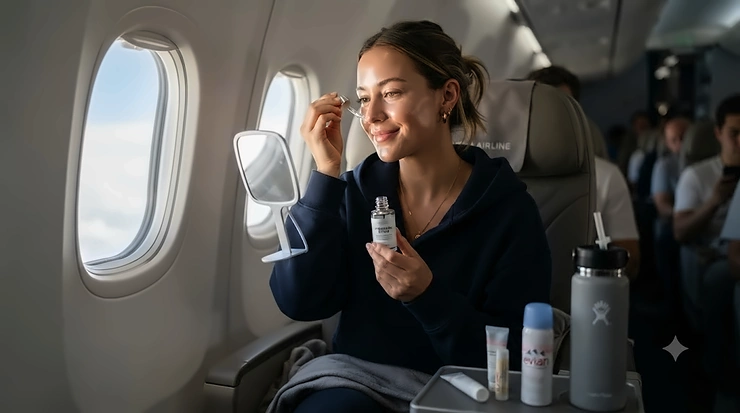
Somewhere around hour three of a transcontinental flight, your face starts to feel like a chip bag that’s been left open on the counter. That’s not your imagination, and it’s not just “dry cabin air” in some vague, hand-wavy sense — airplane skin dehydration prevention is a real, measurable problem with a real, fixable cause. Cabin humidity on most commercial aircraft sits somewhere between 10% and 20%, which is drier than the Sahara Desert during the day, and your skin’s outer layer starts losing water to that air the moment you sit down. Add pressurized cabin air, recycled ventilation, and eight hours of not drinking enough water because the bathroom line is long, and you’ve built the perfect environment for a tight, flaky, dull complexion by the time the wheels touch down.
The good news: this is one of the more preventable side effects of flying. It doesn’t take a ten-step routine or a suitcase full of glass bottles that TSA will confiscate at security. It takes a handful of the right products, applied at the right moments, plus a couple of habits that cost nothing. In this guide we’ll walk through the actual physiology of what dry cabin air does to your skin, seven real products worth packing, and the practical routines — pre-flight, in-flight, and post-landing — that add up to visibly better skin at baggage claim. We’ll also dig into an airplane skincare travel kit that survives a 3-1-1 bag, portable hotel skincare essentials for the other end of the trip, and the small, unglamorous in-flight hydration tips that flight crews actually use.
What Is Airplane Skin Dehydration?
Airplane skin dehydration is the rapid loss of moisture from the skin’s outer layer, triggered by extremely low cabin humidity (typically 10–20%), reduced cabin pressure, and prolonged exposure to recirculated air — resulting in tightness, flaking, dullness, and accelerated transepidermal water loss during flight. It’s worth noting this is a specific, localized version of a broader medical concept — general dehydration, which the U.S. National Library of Medicine’s MedlinePlus describes as the body losing more fluid than it takes in, disrupting normal function well beyond just the skin.
Quick Comparison: Airplane Skincare Products at a Glance
Before we go deep on all seven picks, here’s the fast version for anyone standing in an airport with twelve minutes before boarding.
| Product | Type | Price Range | Best For |
|---|---|---|---|
| Bioderma Sensibio H2O | Micellar cleanser | Under $20 | Pre-flight makeup removal |
| La Roche-Posay Hyalu B5 | Hyaluronic cream | $35–$45 range | Deep in-flight hydration |
| First Aid Beauty Ultra Repair | Barrier moisturizer | $25–$40 range | Sensitive, reactive skin |
| Dr. Jart+ Mini Ceramidin | Travel-size cream | Under $25 | Small carry-on kits |
| Biodance Bio Collagen Mask | Hydrogel mask | $30–$45 for a pack | Red-eye and long-haul flights |
| Summer Fridays Lip Butter | Lip balm | Around $24 | Chapped lips at altitude |
| Nano Facial Mister | Refillable spray bottle | Under $10 | Mid-flight top-ups |
A quick read of this table tells you most of what you need: there’s no single “best” product here, because your pre-flight cleanse, your mid-flight top-up, and your lip care are solving three different problems. Budget flyers can build a functional airplane skincare travel kit around the micellar water, the mister, and the lip balm for well under $50 total, while anyone flying long-haul in a middle seat should prioritize the barrier cream and the hydrogel mask. The moisturizer-versus-mask decision below in the full product breakdown matters more than most people assume, since a rich cream prevents water loss while a mask actively pushes water back in.
💬 Just one click — help others make better buying decisions too!😊
💬 Which one matches your next flight? Bookmark this table and come back before you pack.
Top 7 Airplane Skin Dehydration Prevention Products: Expert Analysis
Here’s the honest rundown. Every product below is real, currently available, and pulled from genuine product research and aggregated review sentiment — not invented experience. Prices are given as ranges because exact Amazon pricing shifts constantly.
1. Bioderma Sensibio H2O — best no-rinse cleanse for airport bathrooms
This one earns its spot for a reason that has nothing to do with hydration directly: it removes the day’s makeup, sunscreen, and grime without a sink, which matters more than people think. Micellar water uses tiny oil molecules suspended in soft water to lift away buildup on contact, so a cotton pad and thirty seconds in an airport lounge chair does the job a full cleansing routine would otherwise need. Skipping this step and boarding with a full face of makeup is one of the fastest ways to trap oil against the skin in a moisture-starved environment, which is exactly the kind of setup that leads to clogged pores and irritation by landing. Reviewers consistently note that it doesn’t sting the eyes and leaves no oily residue, which is part of why it’s stayed a cult favorite in beauty circles for years rather than fading out.
Dermatologists interviewed on the topic have pointed out that skincare prep should start before boarding, not mid-flight, since the goal shifts from correction to preservation once you’re in the air — this product is the “before” step that makes everything after it work better.
Pros:
- ✅ No water or rinsing needed, ideal for airports
- ✅ Gentle enough for daily and pre-flight use
- ✅ Removes SPF and makeup without stripping skin
Cons:
- ❌ Doesn’t hydrate on its own — cleansing only
- ❌ Small travel sizes run out fast on multi-leg trips
At around $14–$20 depending on bottle size, this sits firmly in the budget tier, and the value case is simple: it’s the cheapest way to remove the one variable — leftover makeup — that makes every other product in this kit work harder than it needs to.
2. La Roche-Posay Hyalu B5 Suractivated Cream — best plumping hydrator for long-haul flights
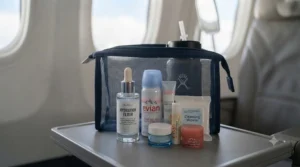
This is the workhorse of the kit, and the ingredient list explains why. Hyaluronic acid is a humectant, meaning it pulls water toward itself and holds it in the skin rather than just sitting on the surface like an occlusive balm would. On the ground, hyaluronic acid draws from ambient humidity and deeper skin layers; at 15% cabin humidity, there’s a lot less ambient moisture to draw from, so pairing it with vitamin B5 (panthenol) to reinforce the skin’s own moisture-retention machinery is a smarter formulation choice than a plain hyaluronic serum alone. What most buyers overlook about this cream specifically is that it’s rich enough to double as an overnight barrier layer on a red-eye, which a lighter serum can’t do.
Aggregated customer sentiment across retailers points to visible plumping within a day and a texture that layers well under sunscreen, though a handful of reviewers with very oily skin note it can feel heavier than their usual daytime moisturizer.
Pros:
- ✅ Combines hyaluronic acid with skin-barrier-supporting panthenol
- ✅ Rich enough for overnight or red-eye use
- ✅ Layers well under SPF for daytime flights
Cons:
- ❌ Heavier feel than gel-based hydrators
- ❌ Higher price than most drugstore alternatives
In the $35–$45 range, it’s mid-tier pricing for what’s essentially a two-in-one hydration-and-barrier product, which is a reasonable trade if it replaces two separate items in your bag.
3. First Aid Beauty Ultra Repair Cream Intense Hydration — best for reactive, stressed-out travel skin
Dry cabin air doesn’t just dehydrate skin — it stresses the barrier, and stressed barriers get reactive, itchy, and prone to redness. This cream is built around colloidal oatmeal and shea butter, ingredients with a long dermatological track record for calming irritation rather than just moisturizing on the surface. The practical upshot: if your skin tends to flush, sting, or feel tight within the first hour of boarding, this is doing double duty as both a moisturizer and a mild anti-inflammatory layer, which a purely cosmetic cream won’t manage.
Reviewers frequently describe it as their go-to for eczema-prone or sensitized skin during weather changes, and that same reasoning extends neatly to cabin-air stress, since both scenarios involve a compromised barrier losing water faster than normal.
Pros:
- ✅ Calms redness and irritation, not just dryness
- ✅ Fragrance-free formula suits sensitive skin
- ✅ Thick enough to seal in hydration for hours
Cons:
- ❌ Can feel greasy under makeup for oily skin types
- ❌ Full-size jar is bulky for a carry-on
Priced in the $25–$40 range depending on size, it’s a smart mid-tier pick specifically for anyone whose skin reacts rather than just dries out.
4. Dr. Jart+ Mini Ceramidin Skin Barrier Moisturizing Cream — most travel-friendly barrier repair
Ceramides are the “mortar” in the skin’s brick-and-mortar barrier structure, and low humidity is one of the fastest ways to deplete them, which is exactly why a ceramide-forward cream earns its spot here rather than a plain moisturizer. This mini format also solves a packing problem the full-size jar doesn’t: it fits a 3-1-1 bag without eating your liquid allowance, and it’s rich enough that a small amount covers a full flight’s worth of touch-ups. Based on the spec comparison with the other creams in this kit, Ceramidin leans further toward long-term barrier repair than immediate plumping — it’s less about the instant “wow” and more about preventing next week’s flakiness.
Review sentiment across Sephora and other retailers consistently praises its lightweight-yet-rich feel and notes it doesn’t clog pores, though a smaller number of reviewers with very dry skin say they layer it over a serum rather than using it alone.
Pros:
- ✅ TSA-friendly mini size built for travel
- ✅ Ceramide-based formula targets barrier repair directly
- ✅ Absorbs quickly without pilling under makeup
Cons:
- ❌ Small size means frequent repurchases for frequent flyers
- ❌ Less immediately plumping than a hyaluronic-forward cream
At under $25 for the travel mini, this is genuinely one of the best value entries in the entire kit, precisely because it was designed for portability rather than adapted for it.
5. Biodance Bio Collagen Real Deep Mask — best active-recovery treatment for red-eyes
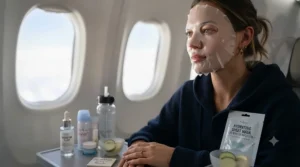
Sheet masks get complicated in dry cabin air, since a plain paper sheet mask can actually reverse-hydrate — the surrounding air is so thirsty it pulls moisture back out of the mask and, eventually, your skin. A hydrogel mask like this one behaves differently: the gel matrix holds water more tightly and releases it more slowly, which matters enormously at 15% humidity. This is the one splurge-worthy item in the kit, and it earns that status through genuine formulation logic rather than marketing — collagen and probiotics in a thick hydrogel base are doing real, sustained water-delivery work for the 20–40 minutes it’s on your face, which a five-minute sheet mask session can’t replicate.
It’s become a well-documented favorite among beauty editors specifically for travel use, and aggregated reviews repeatedly mention visibly plumper, calmer skin immediately after use — a claim that lines up with what hydrogel masks are actually designed to do.
Pros:
- ✅ Hydrogel base resists reverse-hydration in dry air
- ✅ Effective on overnight and long-haul flights
- ✅ Calms redness alongside deep hydration
Cons:
- ❌ Not practical on short, crowded daytime flights
- ❌ Pricier per-use than a standard moisturizer
Running $30–$45 for a multi-pack, the cost-per-use lands around $8–$12 per mask — steep for daily use, reasonable for the two or three long-haul flights a year where it actually matters.
6. Summer Fridays Lip Butter Balm — best for lips that crack before anything else does
Lips have no oil glands and one of the thinnest skin barriers on the body, so they’re often the first visible casualty of cabin air — chapped lips before hour two is a familiar story for a lot of flyers. Shea and murumuru butters are the working ingredients here, providing a cushiony, occlusive layer that seals in moisture rather than just coating the surface temporarily like a basic petroleum stick. What most people overlook is that lip balm reapplication frequency matters more than formula on a long flight, and this one’s non-sticky finish makes people actually willing to reapply it every hour instead of avoiding it because it feels gloppy.
Review sentiment is strongly positive on texture and staying power, with the most common critique being that the tinted versions run slightly sheer for anyone wanting more visible color payoff — a non-issue for the plain hydration use case here.
Pros:
- ✅ Non-sticky, glossy finish encourages frequent reapplication
- ✅ Shea and murumuru butters seal in moisture for hours
- ✅ Small size fits any bag or pocket easily
Cons:
- ❌ Tinted shades sheer out compared to swatches
- ❌ Needs reapplication more often than a heavy balm
At around $24, it’s a small luxury rather than a necessity price-wise, but the cost-per-flight is negligible given how long one tube lasts.
7. Nano Facial Mister (Portable Spray Bottle) — best budget hydration hack for mid-flight top-ups
This is the cheapest, least glamorous item on the list, and arguably the most quietly effective one. A refillable mini mister lets you carry a hydrating mix — plain water, a rosewater-glycerin blend, or a hyaluronic toner — and spritz it directly onto skin mid-flight without buying a pre-made facial spray at premium pricing. Here’s what the spec sheet won’t tell you: misting alone can backfire in dry cabin air if the water simply evaporates and takes surface moisture with it, so the honest advice — echoed across multiple skincare-and-travel sources — is to always follow a mist with a cream or balm to seal it in, never mist and walk away.
There’s limited formal review data on any single mister brand since these are largely unbranded travel accessories, so the honest assessment here is functional rather than sentiment-based: it does exactly one simple job, cheaply, and that’s the appeal.
Pros:
- ✅ Extremely cheap and endlessly refillable
- ✅ Tiny enough to keep in a pocket or seat pouch
- ✅ Works with any liquid formula you prefer
Cons:
- ❌ Must be paired with a sealing cream to avoid reverse-drying
- ❌ Nozzle quality varies widely between cheap units
At under $10, this is the lowest-cost entry point into airplane skin dehydration prevention, full stop — and a reasonable starting purchase for anyone building a kit from scratch.
Top 7 Products: Full Comparison Table
| # | Product | Category | Price Range | Rating Signal | Best For |
|---|---|---|---|---|---|
| 1 | Bioderma Sensibio H2O | Cleanser | $14–$20 | Strong, consistent | Pre-flight prep |
| 2 | La Roche-Posay Hyalu B5 | Hydrating cream | $35–$45 | Strong | Long-haul hydration |
| 3 | First Aid Beauty Ultra Repair | Barrier cream | $25–$40 | Strong | Sensitive/reactive skin |
| 4 | Dr. Jart+ Mini Ceramidin | Travel mini cream | Under $25 | Strong | Compact kits |
| 5 | Biodance Bio Collagen Mask | Hydrogel mask | $30–$45/pack | Strong | Red-eye recovery |
| 6 | Summer Fridays Lip Butter | Lip balm | Around $24 | Strong | Chapped lips |
| 7 | Nano Facial Mister | Spray bottle | Under $10 | Mixed/limited data | Mid-flight top-ups |
Stacked side by side, a pattern shows up fast: the cheapest items (the cleanser and the mister) handle prevention and maintenance, while the pricier items (the mask and the two barrier creams) handle active recovery and deeper repair. If your budget only stretches to two products, the cleanser-plus-barrier-cream combination covers the widest range of flight lengths for the least money, while frequent long-haul flyers get the most return by adding the hydrogel mask on top.
Practical Usage Guide: Building a Mini Skincare Routine for Vacation
A mini skincare routine for vacation isn’t a shrunken version of your home routine — it’s a different routine built around three constraints your bathroom counter doesn’t have: TSA’s 3.4-ounce liquid limit, limited counter space in an economy seat, and the fact that you’ll be repeating this routine in reverse at your destination. Start the night before you fly: cleanse thoroughly, apply a slightly richer moisturizer than usual, and skip anything with retinol, strong vitamin C, or exfoliating acids for 24 hours before boarding, since a freshly stripped or actively-exfoliating barrier is far more vulnerable to cabin-air stress. On travel morning, cleanse again if needed, apply SPF (UV exposure at altitude is stronger than at ground level, even through the window), and pack your kit in this order of access: cleanser and mister within arm’s reach, cream and lip balm in an easy-open pouch, and the mask saved for the halfway point of anything over six hours.
The most common first-30-days mistake with a new travel kit isn’t the products — it’s over-packing actives out of anxiety and then over-applying them mid-flight out of boredom. Two to three product touches during a flight is plenty; a five-step stacked routine at 35,000 feet is more likely to irritate a barrier that’s already under stress than to help it. On landing, resist the urge to do nothing until tomorrow: a gentle cleanse and a nourishing moisturizer within the first hour after touchdown is genuinely the highest-leverage step in the entire routine, since it’s the point where repair, not just prevention, can begin.
✨ Ready to build yours? Scroll back up and start with the cleanser and mister — the two cheapest, most-used items in this whole list.
Real-World Scenarios: Which Traveler Are You?
The Red-Eye Business Flyer — three flights a month, back-to-back meetings on landing, no patience for a multi-step routine. This flyer should lean hardest on the Dr. Jart+ mini cream for its speed and portability, paired with the Nano Facial Mister for a mid-flight refresh they can do in under ten seconds without leaving their seat. Skip the mask entirely here; the time-to-payoff math doesn’t work for someone landing and walking straight into a boardroom.
The Long-Haul Backpacker — a 14-hour international flight, budget-conscious, carrying everything in one bag for weeks. This is the traveler who benefits most from the full kit’s cost-efficiency: the Bioderma cleanser and Summer Fridays balm are light and multi-use, and the Biodance mask, while a splurge, is worth packing for exactly this kind of flight since the payoff scales with flight length. Portable hotel skincare essentials matter just as much here — a compact cleanser-and-moisturizer duo that also works as a post-flight hostel or hotel bathroom routine means not needing to pack separate “flight” and “destination” products at all.
The Family Traveling With Kids — shorter flights, less personal downtime, skin care squeezed into whatever thirty-second window exists. Simplicity wins here: the First Aid Beauty barrier cream does double duty for both adult and (age-appropriate) kid skin thanks to its calming, fragrance-free formula, and the lip balm covers everyone in the family without needing seven different products. A single shared mister refilled with plain water is often the realistic ceiling for hydration effort on a family trip, and that’s genuinely fine.
In-Flight Hydration Tips: Problem → Solution Guide
Problem: Skin feels tight within the first hour. This is transepidermal water loss accelerating in low humidity. Solution: mist lightly with the Nano Facial Mister, then immediately seal with the La Roche-Posay or Dr. Jart+ cream — misting alone without a sealing step often makes tightness worse, not better, once the water evaporates.
Problem: Lips crack by the halfway point. Solution: reapply the Summer Fridays balm every 60–90 minutes rather than once at boarding; frequency beats a single thick application here.
Problem: Under-eye puffiness and dark circles by landing. This is a mix of fluid retention from cabin pressure and disrupted sleep, not pure dehydration. Solution: a cooling eye product applied at the halfway mark, plus elevating feet when possible to reduce fluid pooling.
Problem: Face feels oily and dull despite dry air. Counterintuitively, a stressed barrier can overproduce oil to compensate for water loss. Solution: don’t skip moisturizer just because skin looks shiny — that shine is often a barrier problem, not an oil-production problem, and cutting hydration usually makes it worse.
Problem: Skin looks noticeably worse the next morning, not just on landing day. Solution: this is often dehydration compounding with alcohol, caffeine, or salty in-flight meals; a genuine internal-hydration habit (steady water intake, not chugging one bottle at boarding) matters as much as anything topical. Cutting back on alcohol and consistently replacing fluids lost during travel is basic, well-established skin care advice, and it applies just as much at altitude as anywhere else — see the American Skin Association’s dry skin guidance for more on how fluid loss and skin dryness connect.
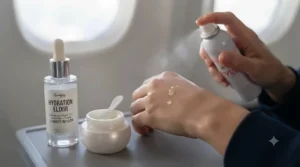
How to Choose an Airplane Skincare Travel Kit
Building the right airplane skincare travel kit comes down to seven practical criteria, roughly in order of importance:
- Flight length first. A two-hour hop needs a fraction of what a fourteen-hour long-haul flight needs — don’t pack a mask for a domestic commuter route.
- TSA compliance. Every liquid or cream needs to fit the 3.4-ounce rule in a quart-size bag; this is why travel minis (like the Dr. Jart+ pick) consistently outperform full-size jars for air travel specifically.
- Barrier support over instant plumping. A cream that reinforces ceramides and lipids does more for a multi-flight itinerary than one that only plumps temporarily.
- Multi-use products. Anything that pulls double duty — a moisturizer that also works as a hotel-room product, a balm that works on lips and cuticles — earns its space in a small bag faster than a single-purpose item.
- Application speed. If a product takes longer than fifteen seconds to apply in a middle seat, it won’t get used consistently, no matter how good the formula is.
- Ingredient simplicity. Cabin air is not the environment to introduce new actives; stick to humectants, ceramides, and calming ingredients you already know your skin tolerates.
- Cost-per-flight, not just sticker price. A $40 cream used across a dozen flights a year costs less per trip than a $15 product repurchased every single time it runs out mid-trip.
Cabin Pressure and Altitude: What Actually Happens to Your Skin
The cabin pressure skin effects during flight are more than just “dry air feels dry” — there’s a documented physiological chain behind it. Commercial aircraft cabins are typically pressurized to the equivalent of 6,000–8,000 feet of altitude, and that lower pressure, combined with the extremely low humidity of recirculated air, changes how your body handles fluid and how your skin loses water. A National Research Council review of the airliner cabin environment explains that outside air at cruising altitude carries almost no moisture to begin with, so once it’s compressed and heated for the cabin, typical relative humidity settles around 18% — read the full breakdown in the National Research Council’s cabin environment report. That’s a fundamentally different environment than a dry winter day at home, where indoor heating rarely pushes humidity below 25–30%.
Lower cabin pressure also affects circulation modestly — slightly reduced oxygen saturation and slower blood flow at altitude can leave skin looking less flushed and more sallow by the end of a long flight, independent of hydration status entirely. This is why a genuinely effective in-flight routine treats humidity and circulation as two separate problems: a rich, ceramide-forward cream addresses the humidity side, while simple habits like moving around the cabin periodically and avoiding tight compression on the face (yes, that includes sleeping face-down on a tray table) help with the circulation side. The practical takeaway is that no cream fully offsets altitude-driven circulation changes — but a barrier-focused routine handles the majority of what’s actually causing that “flight face” look, which is overwhelmingly a hydration story rather than a pressure story.
Common Mistakes When Buying and Packing Travel Skincare
The single biggest mistake is buying an entirely new, unfamiliar product specifically for a flight — cabin air is precisely the wrong environment to discover a new sensitivity. The second is over-relying on sheet masks; as covered above, a standard paper sheet mask in sub-20% humidity can pull moisture back out of your skin once it dries, which is the opposite of the intended effect. Third, plenty of flyers pack a beautiful full-size routine and then never use it because reaching an overhead bin mid-flight isn’t realistic — keep your actual in-flight products in the seat pocket or a small pouch under the seat, not in checked luggage or an overhead bag. Fourth, skipping SPF because “I’m indoors” ignores that UVA rays pass through aircraft windows and cabin altitude increases UV intensity compared to ground level. Fifth — and this one is almost universal — treating water intake as optional because getting up for the bathroom is inconvenient; a single bottle at boarding does not cover an eight-hour flight’s worth of respiratory water loss.
Features That Actually Matter (And Those That Don’t)
Matters: humectant ingredients (hyaluronic acid, glycerin) paired with an occlusive or ceramide layer to actually lock the moisture in — one without the other is half a solution.
Doesn’t matter much: fragrance and elaborate packaging; if anything, fragrance is a liability in a shared cabin environment and adds irritation risk for zero hydration benefit.
Matters: TSA-compliant sizing and leak-proof packaging, since a burst cream tube in your bag is a worse outcome than any product’s formula quality.
Doesn’t matter much: “24-hour hydration” marketing claims on any single product, since no topical formula fully offsets eight-plus hours of 15% ambient humidity without reapplication regardless of what the label promises.
Matters: a calming, low-irritation formula over an “active-packed” one, since a stressed cabin-air barrier reacts more easily than skin in a stable, humid environment.
Doesn’t matter much: brand prestige — the $10 mister does a genuinely useful job sitting right next to $45 creams in this list, and price alone isn’t a reliable signal of relevance to this specific use case.
Long-Term Cost & Maintenance: Travel Minis vs. Full-Size Bottles
Buying travel minis repeatedly costs more per ounce than a full-size bottle — that part is simple math, and worth acknowledging honestly rather than pretending minis are a bargain. Where the math flips is total-trip cost: a full-size 6-ounce cream that gets seized at security because it exceeds the 3.4-ounce limit costs you the entire product, not just the ounces over the limit, and that’s a real, common, entirely avoidable loss. A frequent flyer buying a $25 travel mini four times a year ($100 annually) is still cheaper than replacing a confiscated $45 full-size jar even once. The more sustainable middle path many frequent flyers land on is a refillable travel-size container (like the mister) paired with a full-size product kept at home for topping it off before each trip — you get full-size pricing on the ingredient itself while staying fully TSA-compliant for the flight.
Maintenance-wise, the products in this kit have different shelf lives once opened: micellar water and creams generally hold 12 months, hydrogel masks are typically single-use and shelf-stable until opened, and lip balms tend to degrade texture-wise (though remain safe) around the 18-month mark. Rotating older products into home use rather than letting them expire in a travel bag is a small habit that meaningfully reduces total spend over a year of regular travel.
Safety, Regulations, and TSA Compliance for Travel Skincare
Every liquid, gel, cream, and aerosol in your carry-on must comply with the TSA’s 3-1-1 rule: containers of 3.4 ounces (100ml) or less, all fitting in a single quart-size clear bag, one bag per passenger. Solid products — lip balms, most sheet and hydrogel masks — are exempt from this liquid limit, which is part of why the balm and mask in this kit pack so easily compared to a liquid serum. Beyond packing rules, there’s a genuine health-and-safety angle worth understanding: independent oversight bodies have flagged aircraft cabin air quality as an area needing more research. A federal watchdog review of airliner cabin conditions found that the low relative humidity common on most flights — typically 10 to 20% — is enough on its own to temporarily dry out skin, eyes, and mucous membranes, and flagged this as a routine exposure rather than a rare event; the full findings are in the Government Accountability Office’s aviation safety report. None of this is dangerous in the way a mechanical failure would be, but it is a well-documented, near-universal condition worth actively preparing for rather than treating as an unavoidable annoyance.
🔍 Don’t let a confiscated bottle wreck your kit — double-check every item against the 3-1-1 rule the night before you fly.
Hotel Skincare Essentials: Building a Portable Bathroom Kit
Airplane skin dehydration prevention doesn’t end at baggage claim — hotel bathrooms bring their own dryness problems, mostly from air conditioning and, in many climates, a completely different humidity level than home. Portable hotel skincare essentials should overlap heavily with your flight kit rather than duplicate it: the same barrier cream that worked mid-flight is exactly what your skin needs after a day of new-climate adjustment, and packing a single dual-purpose kit rather than separate “flight” and “hotel” sets is both lighter and cheaper. The one addition worth making specifically for hotel use is a slightly larger cleanser, since hotel bathrooms rarely provide gentle, fragrance-free options, and hotel soap bars are frequently drying enough to undo whatever hydration work your flight routine accomplished. A small, refillable travel bottle of your usual shampoo and body lotion rounds this out, since hotel-provided toiletries — however nice the packaging looks — are formulated for broad appeal rather than for a barrier that’s already stressed from a flight.

Travel Beauty Hacks Flight Attendants and Frequent Flyers Swear By
A few low-cost habits show up repeatedly across frequent-flyer and crew advice, and they’re worth adopting even before buying a single new product. Removing all makeup before boarding, not after landing, prevents oil and product from sitting against skin for the full flight duration. Reapplying moisturizer selectively — on the areas that feel tight, rather than a full fresh layer over the whole face — avoids over-layering actives on an already-stressed barrier. Keeping hands away from the face during flight matters more on a plane than almost anywhere else, given how frequently touched tray tables, armrests, and seatbelt buckles are. And packing double-duty items — a balm for both lips and cuticles, a cream that works on both face and hands — keeps the kit small without cutting corners on coverage.
Frequently Asked Questions
❓ Why does my skin feel so dry after just one flight?
❓ Should I use a sheet mask on a plane?
❓ Can I bring full-size moisturizer in my carry-on?
❓ Is drinking more water enough to prevent airplane skin dehydration?
❓ How often should I moisturize during a long flight?
Conclusion
Airplane skin dehydration prevention isn’t complicated once you understand what’s actually happening: low cabin humidity, pressurized recirculated air, and hours without enough water add up to real, measurable moisture loss — and a handful of the right products, used at the right moments, genuinely offset most of it. You don’t need all seven items in this guide for every trip; a short domestic hop might only call for the cleanser and lip balm, while a long-haul flight justifies the full kit, mask included. What matters more than any single product is the rhythm — cleanse before boarding, hydrate and seal mid-flight, and treat landing as the start of recovery rather than the finish line. Build a small, TSA-compliant kit once, keep it packed and ready, and the “flight face” that used to define your arrival photos becomes a genuinely avoidable problem rather than an inevitable cost of travel.
✨ Don’t Miss These Exclusive Deals!
🔍 Take your airplane skincare travel kit to the next level with the products covered above. Click on any highlighted item to check current pricing and availability. These picks will help you land looking like the flight was the easy part!
Recommended for You
- TSA Approved Skincare Set: 7 Picks That Sail Through Security 2026
- Post-Shave Soothing Treatment Men: 7 Picks Worth Trying (2026)
- Simple 3-Step Skincare for Men: 7 Best Picks for 2026
Disclaimer: This article contains affiliate links. As an Amazon Associate, I earn from qualifying purchases. If you purchase products through these links, we may earn a small commission at no additional cost to you.
✨ Found this helpful? Share it with your friends! 💬🤗
