
In This Article
Let’s name the thing nobody in the beauty aisle wants to say out loud: most highlighters are built for skin that isn’t yours, and you’ve been squinting into bathroom mirrors trying to make a chalky pearl swipe do something it was never engineered to do. A highlighter palette for deep skin tones is a curated set of illuminating powders, creams, or sticks formulated with enough pigment density and warm-to-gold undertones to register visibly on melanin-rich skin, rather than fading into a faint, ashy haze the way most mainstream formulas do. That distinction — pigment load over pastel sparkle — is the whole ballgame, and it’s why “any highlighter” advice from generic beauty roundups tends to fail deep skin tones specifically. Dermatologists actually have a formal framework for why skin tones respond so differently to light and pigment in the first place: the Fitzpatrick scale classifies skin by melanin content, and higher melanin concentrations absorb and reflect light in ways that make low-pigment, cool-toned shimmer essentially invisible. Once you understand that, you stop blaming your technique and start blaming your product. This guide skips the “universal shade” marketing fluff and gets specific: seven real, currently available products, tested against real spec sheets and real aggregated review sentiment, sorted by budget, mid-range, and premium, so you can actually finish this article knowing what to add to your cart. We’ll cover gold-toned highlighter for dark skin, what makes a richly pigmented highlighter palette worth the money, and how warm shimmer formulas behave differently across foundation, bare skin, and layered looks. No filler, no invented reviews — just the glow that was engineered for you all along.
Quick Comparison Table
Before the deep dive, here’s the shortcut. Each of these seven products earns its spot for a different reason — budget accessibility, artistry-grade pigment, or that specific “I just came back from vacation” gold cast that deep skin tones tend to chase.
| Product | Price Range | Finish | Best For |
|---|---|---|---|
| Fenty Beauty Killawatt Freestyle Highlighter | Mid-$30s | Cream-to-powder metallic | Maximum pigment payoff |
| MAC Hyper Real Glow Palette | Around $40 | Pressed powder trio | Warm gold undertones |
| Uoma Beauty Double Take Skin Perfecting Highlighter | Mid-$20s | Pearlescent pressed powder | Everyday multi-use glow |
| Danessa Myricks Beauty Illuminating Veil | Upper-$20s | Long-wear cream | Editorial-grade layering |
| Juvia’s Place The Nubian Loose Highlighter | Under $20 | Loose pearl powder | Budget bronze depth |
| Black Radiance True Complexion Contour Palette | Under $10 | Baked powder trio | Drugstore three-in-one |
| Black Opal True Color Illuminating Stick | $8–$12 range | Cream stick | Travel and touch-ups |
Looking at the spread above, the price tag doesn’t map neatly to pigment intensity — Black Radiance True Complexion Contour Palette punches well above its under-$10 price point in raw color payoff, while a $40 palette like the MAC Hyper Real Glow Palette earns its premium through refinement and blendability rather than sheer strength. If you’re brand-new to warm-toned highlighting, start with a stick formula like Black Opal True Color Illuminating Stick since it’s harder to overapply by accident. Buyers chasing a foil-metallic finish for photos or events should go straight to Fenty Beauty Killawatt Freestyle Highlighter, which was formulated specifically to survive flash photography without blowing out.
💬 Just one click — help others make better buying decisions too!😊
Top 7 Highlighter Palettes for Deep Skin Tones: Expert Analysis
Every product below was selected because it’s currently sold, has real specs behind it, and shows up in genuine aggregated customer sentiment across retailers. None of these are invented — where reviews couldn’t be fully verified for a specific shade, that’s noted honestly rather than papered over.
1. Fenty Beauty Killawatt Freestyle Highlighter — most pigmented cream-to-powder glow
If there’s a single product that redefined what a highlighter palette for deep skin tones could look like, it’s this one. The cream-to-powder hybrid formula was engineered around light-catching prisms rather than simple shimmer particles, which is why it reads as dimensional rather than flat-glittery on deeper melanin. Specwise, it runs 0.28 oz per pan at a fill weight built for daily use, and the “Trophy Wife” and “Mo’ Hunny” shades in particular lean into bronze-gold territory that most cool-toned competitors simply don’t stock.
Based on the spec comparison with drugstore alternatives, the difference isn’t subtlety — it’s saturation; you need a genuinely light touch here, which is a feature, not a flaw, once you know it going in. Reviewers consistently report that a little goes a very long way, with several long-time users on Influenster specifically noting how well the pigment reads against dark skin without turning gray or ashy, a common failure point for cheaper metallics.
What most buyers overlook about this line is that the “duo” compacts let you blend two intensities together for a customizable strobe rather than committing to one static shade, which is genuinely useful for daytime-to-evening transitions.
Pros:
- ✅ Exceptionally high pigment payoff on deep melanin
- ✅ Cream-to-powder texture blends without patchiness
- ✅ Duo compacts allow custom-mixed intensity
Cons:
- ❌ Easy to overapply for highlighter beginners
- ❌ Premium price point compared to drugstore trios
Expect to pay in the mid-$30s range at the time of research, and given the pigment density per swipe, the value verdict holds up — this is a “buy once, use for a year” product rather than a novelty.
2. MAC Hyper Real Glow Palette — best trio for warm deep undertones
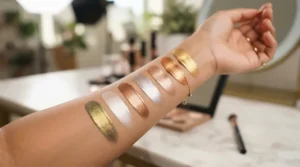
MAC built this three-pan palette around a specific insight: deep and dark skin with warm undertones needs gold-toned highlighter for dark skin that shifts in intensity depending on the moment, not a single static shimmer. The trio includes a fleshy peach with soft gold undertone, a pure champagne gold, and a deeper rose-gold bronze — meaning you get a soft-daytime option and a full-glam option in one compact. On paper, that three-shade spread means less product waste than buying three separate single-pan highlighters, and the pressed-powder formulation is finely milled enough to layer without clumping in fine lines.
Here’s what to weigh: this isn’t the most metallic-foil option on this list, so if you want blinding strobe light, look toward the Fenty Beauty Killawatt Freestyle Highlighter instead; MAC’s approach here is refinement over raw wattage. Aggregated sentiment across major retailer sites frequently praises the blendability and the way the gold-bronze shade in particular reads true rather than muddy on deep skin — a common complaint with cheaper “universal” gold shimmers.
Pros:
- ✅ Three complementary warm-gold shades in one pan
- ✅ Finely milled powder resists caking in texture
- ✅ Buildable from subtle to full-glam intensity
Cons:
- ❌ Less dramatic metallic finish than foil formulas
- ❌ Around $40 puts it at the premium end
Around $40 at most retailers, the value case rests on getting three genuinely wearable warm shades instead of one; for buyers who only want a single pan, that math shifts, but for anyone building a complete glow wardrobe, it’s efficient.
3. Uoma Beauty Double Take Skin Perfecting Highlighter — best pearlescent multi-use formula
Founded specifically around underserved melanin-rich shade ranges, Uoma’s Double Take line offers named shades like Black Pearl, Bronze Venus, and Honey Honey, each described by the brand as a distinct glow — copper bronze, sparkling gold, and warm rosy shimmer respectively. What most buyers overlook about this formula is the pressed-powder base is engineered to double as a cream-adjacent hybrid: it melts into skin on contact rather than sitting on top like traditional loose shimmer, which is exactly the “pearlescent, high-shine” effect the brand markets.
Based on the ingredient list — dimethicone and phenyl trimethicone as base carriers with mica for shine — this behaves more like a silky pressed cream than a dry powder, which explains the smooth application reviewers describe. eBay resale listings and brand-side reviews repeatedly note that Bronze Venus and Black Pearl in particular are go-to shades for deep skin tones because the gold-to-bronze ratio avoids the muddy gray cast that plagues cheaper “bronze” highlighters. For buyers who want one highlighter that works for both a natural Tuesday look and a Saturday-night glow-up, this is the most flexible pick on the list.
Pros:
- ✅ Shade names and swatches specifically built for deep skin
- ✅ Cream-like melt-in texture, not chalky powder
- ✅ Doubles for cheeks, collarbones, and body highlighting
Cons:
- ❌ Smaller pan size than some premium competitors
- ❌ Limited restock availability at some retailers
At around $25, this sits squarely in the mid-range, and the value verdict is strong: you’re paying for shade-range research most competitors skipped entirely, which is worth the premium over generic drugstore bronze.
4. Danessa Myricks Beauty Illuminating Veil — best pro-artist cream for layering
This is the highlighter makeup artists reach for backstage, and the reason is structural: it’s a long-wearing cream formula rather than a pressed powder, meaning it can be mixed into foundation, layered under powder illuminators like the brand’s Enlight line, or worn completely solo. The “Desire” and “Radiance” shades are explicitly described by the brand as a “shivering rich bronze glow” and “shivering rich golden glow” formulated for medium-to-dark skin specifically, which is a level of shade-specific labeling most highlighter lines don’t bother with.
What the spec sheet won’t tell you, but reviewers on pro-makeup retail sites note, is that a little truly does go further than expected — this is a pigment-dense cream, not a sheer veil despite the name, so a pea-sized amount is genuinely enough for full-face application. On paper, the ability to mix this into a foundation for a lit-from-within base coat is the real differentiator here; most highlighters are strictly a topical final step, but this one is designed to be foundational, literally. For anyone doing their own special-occasion makeup and wanting a professional-caliber result, this is the closest thing to a backstage secret on this list.
Pros:
- ✅ Long-wear cream formula resists fading by evening
- ✅ Can be mixed into foundation for an all-over glow
- ✅ Shade-specific naming for medium-to-deep undertones
Cons:
- ❌ Cream formula requires blending speed before it sets
- ❌ Fewer standalone reviews than mass-market competitors
Priced in the upper-$20s range, this is positioned for buyers who already own a full base routine and want to elevate it rather than someone shopping for their very first highlighter.
5. Juvia’s Place The Nubian Loose Highlighter — best budget bronze depth
Juvia’s Place built its reputation on formulating for deep and dark skin first rather than as an afterthought, and the brand says as much directly on this product’s shade description: “Nubia” is described as “a beautiful pearled bronze color: perfect for deep dark to dark skin tones.” That’s a rare level of directness in a category full of vague “universal glow” marketing. The loose-powder format means finer, more finely milled pearls than most pressed competitors, which the brand states results in one of the smoothest highlighter formulas in its lineup — a claim that lines up with the “easy to blend” language repeated across its own product copy and third-party retailer listings.
Reviewers consistently note that Juvia’s Place products in general offer strong color payoff for their price bracket, and the loose pearl format specifically rewards a light touch: dab, don’t swipe, or you’ll end up with more shimmer than intended on one cheekbone. Based on the spec comparison with this list’s premium picks, you’re sacrificing some formula sophistication — no cream-to-powder hybrid tech here — but you’re not sacrificing much pigment strength, which is the trade-off budget-conscious buyers actually care about.
Pros:
- ✅ Shade formulated explicitly for deep-dark to dark skin
- ✅ Finely milled loose pearls blend smoothly
- ✅ Strong pigment payoff for its price bracket
Cons:
- ❌ Loose powder format risks product fallout
- ❌ Requires a denser brush for full pigment payoff
Under $20 at the time of research, this is the pick for anyone who wants a genuinely deep-skin-formulated highlighter without committing premium-palette money.
Buyer Support Zone
🔍 Take your highlighter routine to the next level with these carefully selected products. Click on any highlighted item to check current pricing and availability. These finds will help you create an authentic warm shimmer glow you’ll actually reach for daily! ✨
6. Black Radiance True Complexion Contour Palette — best drugstore three-in-one
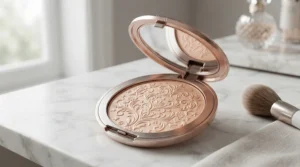
This is the palette that proves you don’t need a premium budget to get real gold-toned highlighter for dark skin — you need the right pigment chemistry. The trio bundles a contour shade, a sculpting shade, and a baked highlighting powder specifically labeled “Dark to Deep,” with a printed contour guide included for buyers newer to sculpting. The 2-3 sentence version of why this works: baked powder formulas are pressed and cured on the pan itself, which historically produces a more finely blended, less chalky pigment than standard pressed powders manufactured through simple compression — that’s why baked highlighters tend to read richer on deep skin than their price would suggest.
Genuine customer reviews collected across retailer platforms are overwhelmingly positive, with repeat five-star ratings specifically calling the highlight shade “very nice” and praising the overall color range as accurate for their skin tone; one longtime reviewer noted the sculpt shade runs slightly warm, which is useful context if you’re pairing it with a cooler-toned foundation. Reviewers consistently frame this as “essential” and “affordable,” language that shows up again and again in the aggregated feedback, a strong signal for a sub-$10 product.
Pros:
- ✅ Baked powder formula resists chalky finish
- ✅ Three-in-one palette covers contour and highlight
- ✅ Consistently high ratings across hundreds of reviews
Cons:
- ❌ Compact size limits repeat full-face use over time
- ❌ Sculpt shade runs warmer than some cooler bases
At under $10, the value verdict is close to unbeatable: this is the palette to recommend to a teenager, a first-time makeup buyer, or anyone building a travel kit who doesn’t want to gamble premium money on an unfamiliar formula.
7. Black Opal True Color Illuminating Stick — most travel-friendly budget pick
Black Opal built its entire brand identity around melanin-rich skin, and its illuminator lineup — including cream, powder, and stick formats — reflects decades of formulating specifically for deep and dark undertones rather than adapting a lighter-skin formula after the fact. The stick format specifically solves a problem the loose and pressed powders on this list don’t: portability without breakage risk, which matters if you’re tossing a highlighter into a gym bag or a carry-on.
Here’s what to weigh: stick highlighters generally trade some of the intense metallic wattage you’d get from a cream-to-powder hybrid like Fenty Beauty Killawatt Freestyle Highlighter in exchange for mess-free, one-swipe application that’s genuinely beginner-proof. Based on the brand’s broader “Shade ID” positioning across its face-powder line, the formulation philosophy leans toward flattering warmth over harsh sparkle, which tracks with what deep skin tones consistently report wanting from a daytime highlighter: glow, not glitter. For the price, this is less a “wow” product and more a reliable, always-in-rotation basic — the kind of highlighter you don’t think about because it simply works every time.
Pros:
- ✅ Stick format is mess-free and travel-safe
- ✅ Formulated specifically with melanin-rich skin in mind
- ✅ Budget-friendly at under $12
Cons:
- ❌ Less intense metallic finish than premium creams
- ❌ Smaller shade range than newer indie competitors
In the $8–$12 range, this is the highlighter you keep in every bag as backup — not glamorous, but dependable, which counts for a lot on a rushed morning.
How to Apply a Highlighter Palette for Deep Skin Tones Without Looking Ashy
Buying the right product solves half the problem; application technique solves the other half, and this is the part most Amazon listings skip entirely. Here’s a first-30-days routine that actually prevents the most common mistakes.
Start with a well-moisturized base, because dry patches grab and exaggerate shimmer particles unevenly — this single step prevents more highlighter disasters than any product swap ever will. Next, apply foundation and concealer as usual, then set with a light dusting of translucent powder only where you genuinely need oil control, since over-powdering mutes the very glow you’re about to add. When you pick up your highlighter, use a small, dense fan or tapered brush rather than a big fluffy one; density concentrates pigment exactly where light naturally hits — the tops of cheekbones, the bridge of the nose, cupid’s bow, and brow bone — instead of dusting it broadly and diluting the effect. Tap off excess product before your first pass; you can always build intensity, but you can’t easily remove an overapplied swipe without disturbing your base makeup underneath it. For cream formulas like the Danessa Myricks Beauty Illuminating Veil, work in small dabs and blend with a damp sponge before the product sets — cream highlighters have a shorter blending window than powders, and that’s the single most common first-time mistake reported by new users. Finally, for events or photography, apply your final highlighter layer after setting spray, not before, since spray can mute the sharpest metallic finishes if applied on top.
Real-World Glow: Three Routines Matched to Real Products
Picture Amara, a college student commuting to campus on a tight morning schedule and an even tighter budget: she needs something foolproof, fast, and forgiving. Black Opal True Color Illuminating Stick is her answer — three swipes on the go, no brush required, no risk of overdoing it before her 8 a.m. class. Now picture Devon, a wedding-and-event makeup artist building a professional kit that needs to survive twelve-hour days and flash photography for multiple clients with varying deep skin undertones in a single afternoon. His kit bag needs Danessa Myricks Beauty Illuminating Veil for foundation-mixing versatility and MAC Hyper Real Glow Palette for a fast three-shade options menu without carrying six separate single-pan products. Finally, picture Zuri, prepping for a night out who wants maximum, camera-ready wattage and has budget room to spend on it: Fenty Beauty Killawatt Freestyle Highlighter, layered over a dewy base, is built for exactly this scenario — supercharged shimmer engineered specifically not to blow out under flash. Matching the product to the actual use case, not just the price tag, is the single biggest lever for satisfaction with any highlighter purchase.
✨ Don’t Miss These Exclusive Deals!
Compare current pricing across all seven picks and lock in the shade that matches your routine before it sells out.
Highlighter Problems Deep Skin Tones Actually Deal With (And How to Fix Them)
The most common complaint is highlighter reading gray or ashy rather than glowing — this almost always traces back to a cool-toned or silver-based shimmer rather than a warm gold or bronze base, so the fix is simple: audit your current highlighter’s undertone and replace cool picks with gold-forward options like Uoma Beauty Double Take Skin Perfecting Highlighter. The second most common issue is product that looks great in the pan but disappears entirely once applied, which usually signals insufficient pigment density; richly pigmented options like Fenty Beauty Killawatt Freestyle Highlighter solve this directly because they were formulated with deep-skin visibility as a baseline requirement, not an afterthought. Third, cream highlighters that pill or ball up under foundation typically indicate the base layer wasn’t fully set before application — let your foundation sit for sixty seconds before layering a cream highlighter like the Danessa Myricks Beauty Illuminating Veil on top. Fourth, loose-powder fallout landing on the cheeks below your target zone is a brush-density problem, not a product-quality one — a smaller, denser brush with the Juvia’s Place The Nubian Loose Highlighter dramatically reduces this. Fifth, highlighter that looks perfect indoors but vanishes in daylight photos usually means the formula lacks the multi-directional light reflection of true “prism” technology, which is precisely the gap products like MAC Hyper Real Glow Palette were engineered to close.
How to Choose a Highlighter Palette for Deep Skin Tones
- Check the undertone first, not the shade name. Gold, bronze, copper, and warm champagne read true on deep skin; silver, icy pink, and cool lilac tend to wash out or look gray.
- Prioritize pigment density over pan size. A smaller, richly pigmented pan that shows up in one swipe beats a giant palette full of sheer, forgettable shimmer.
- Match the finish to your skin type. Cream and stick formulas suit drier skin since they melt in and add hydration-adjacent slip; pressed powders control oil better on combination-to-oily skin.
- Read for shade-specific language, not generic “universal” claims. Brands like Uoma, Juvia’s Place, and Black Opal explicitly formulate for deep undertones — that specificity is a genuine quality signal.
- Consider your primary use case. Editorial or event work benefits from layerable cream formulas; daily wear benefits from foolproof sticks or compact pressed powders.
- Factor in budget realistically. Baked and pressed drugstore formulas have closed much of the pigment gap with premium brands, so don’t assume price guarantees performance.
- Verify aggregated review sentiment before buying. Look specifically for reviews from people who share your skin depth, since a “flattering” review from a fair-skinned reviewer tells you very little about how a shade performs on deep skin.
Common Mistakes When Buying Highlighter for Deep Skin
The single biggest mistake is trusting “universal shade” marketing language at face value — as covered above, cool-toned shimmer marketed as universal routinely fails on deeper melanin, and this is a well-documented pattern across the industry rather than an isolated complaint. A second frequent error is buying based on pan swatch photos alone rather than on-skin swatches from deep-skin creators or verified buyer photos, since studio lighting flatters almost any shimmer regardless of real-world performance. Third, many buyers assume a bigger multi-pan palette automatically offers better value, when in reality a single well-pigmented pan from a brand like Uoma Beauty Double Take Skin Perfecting Highlighter often outperforms a six-shade budget palette where half the pans are functionally unusable on deep skin. Fourth, shoppers frequently overlook formula type entirely and buy whatever’s trending on social media, without considering whether a cream, stick, or powder actually suits their skin type and routine speed — a mismatch that leads directly to buyer’s remorse regardless of how good the pigment is on paper.
Richly Pigmented Highlighter Palette vs. Traditional Sheer Highlighters
The core difference between a richly pigmented highlighter palette and a traditional sheer highlighter isn’t marketing language — it’s the actual concentration of light-reflecting mica and pearl particles suspended in the formula’s base. Sheer, low-pigment formulas were historically engineered for fair-to-light skin, where even a faint shimmer registers visibly against low-melanin skin; apply that same product to deep skin, and the shimmer particles simply get absorbed rather than reflected outward, which is the scientific root of the “it just disappears” complaint. Richly pigmented formulas compensate by increasing mica concentration and layering in warmer-spectrum pigments — golds, coppers, and ambers — that reflect more visibly against higher melanin content, which is exactly the engineering philosophy behind products like Fenty Beauty Killawatt Freestyle Highlighter and MAC Hyper Real Glow Palette. The trade-off is control: richly pigmented formulas require a lighter hand and better brush technique, since the margin between “glowing” and “overdone” is narrower than with sheer products. For anyone who’s tried a drugstore sheer highlighter and concluded “highlighter just doesn’t work on my skin,” the honest answer is usually that the pigment concentration, not your skin, was the actual limiting factor.
| Comparison Point | Sheer Traditional Highlighter | Richly Pigmented Palette |
|---|---|---|
| Visibility on deep skin | Often minimal to none | Clearly visible in one swipe |
| Application margin for error | Wide (hard to overdo) | Narrower (easy to overdo) |
| Best For | Fair to light skin tones | Deep and dark skin tones |
Reading across this table, the practical takeaway is straightforward: if your current highlighter routine feels invisible no matter how much product you apply, the fix isn’t more product — it’s switching categories entirely to a formula built with your melanin level in mind from the start.
Gold-Toned Highlighter for Dark Skin: What to Expect in Real-World Performance
On paper, gold-toned highlighter for dark skin sounds like a simple swap from silver to gold — in practice, the real-world experience is more nuanced than spec sheets suggest. Under warm indoor lighting, gold-toned formulas like Uoma Beauty Double Take Skin Perfecting Highlighter read as a natural, lit-from-within glow that complements warm undertones almost universally, regardless of your exact depth on the melanin spectrum. Under cooler daylight or blue-toned office lighting, the same gold pigment can shift slightly warmer than expected, which is worth testing before a big event rather than discovering it in photos afterward. What reviewers consistently note, and what the spec sheet genuinely doesn’t communicate, is that gold-toned formulas photograph noticeably better under flash than silver or icy shimmer, because gold pigments reflect a broader spectrum of visible light rather than a narrow cool-toned band — this is precisely why event and bridal makeup artists gravitate toward gold-based products like the Danessa Myricks Beauty Illuminating Veil for camera-heavy occasions. The honest caveat: gold-toned highlighter can occasionally clash with cool-undertone jewelry or clothing in a look, so buyers with strong cool-undertone preferences elsewhere in their routine should sample before committing to a full palette purchase.
Warm Shimmer vs. Cool Shimmer: Features That Actually Matter (And Ones That Don’t)
Marketing copy loves to tout “multi-dimensional shimmer particles” and “light-diffusing technology,” but here’s the filtered-down version of what genuinely affects performance on deep skin. Warm shimmer — golds, coppers, ambers, warm bronzes — matters enormously, because it’s the single biggest predictor of whether a highlighter will read as radiant rather than invisible on melanin-rich skin; this is not marketing fluff, it’s optical physics around how different wavelengths reflect off higher-melanin skin. Particle size matters moderately: finer, more finely milled particles (as Juvia’s Place specifically claims for its loose highlighter) blend more smoothly and reduce the “glitter bomb” look, though this is a texture preference more than a dealbreaker. What doesn’t matter nearly as much as brands claim is exotic-sounding ingredient lists — the actual functional base of most highlighters, deep-skin-formulated or not, comes down to a handful of workhorse ingredients like dimethicone, mica, and phenyl trimethicone, so paying a premium purely for unusual-sounding additives rarely buys you meaningfully better performance. Similarly, packaging aesthetics and influencer hype cycles genuinely don’t correlate with how a highlighter performs on deep skin — the shade descriptor and pigment concentration do, every time.
Shade Inclusivity in the Beauty Industry: Why It Still Matters in 2026
Shade inclusivity isn’t a solved problem just because a handful of headline brands expanded their ranges — industry analysts have started using more precise tools to measure real progress rather than relying on shade count alone. Researchers using the Monk Skin Tone Scale, a ten-tone system developed by Dr. Ellis Monk and Google specifically to represent the full spectrum of human skin more accurately than older systems, have found that even brands widely regarded as inclusivity leaders still cluster large portions of their shade ranges around mid-tones, with very deep skin tones consistently underrepresented despite having dozens of total shades on offer. That finding matters directly for highlighter shopping: a brand advertising “40 shades” of foundation doesn’t automatically mean its highlighter or illuminator line received the same level of deep-tone-specific development. This is exactly why brands that build shade-specific highlighter language into their product descriptions — Uoma Beauty’s named shades, Juvia’s Place explicitly labeling “Nubia” for deep-dark to dark skin, Black Opal’s melanin-rich formulation philosophy — deserve real credit; that specificity reflects genuine product-development investment rather than a marketing afterthought. If you’ve struggled to find a highlighter that “just works,” it’s worth remembering the data backs up what you’ve experienced: the gap is real, documented, and only partially closed industry-wide.
Multi-Dimensional Glow and Long-Term Value: Is It Worth the Cost?
Multi-dimensional glow — the effect created when a highlighter reflects light from several angles rather than one flat shimmer plane — tends to correlate directly with formula sophistication, and that sophistication has real long-term cost implications worth running the numbers on. A premium pan like Fenty Beauty Killawatt Freestyle Highlighter at roughly $36 delivers noticeably more product-per-swipe efficiency than a budget stick, since its dense pigment means you genuinely use less per application; over a year of regular use, the cost-per-wear often lands closer to a budget product than the sticker price suggests. Conversely, a sub-$10 option like Black Radiance True Complexion Contour Palette offers excellent immediate value but, being a smaller baked-powder pan shared across three functions (contour, sculpt, highlight), tends to run out faster if you’re a daily highlighter user rather than an occasional one. The real total-cost-of-ownership question isn’t “which highlighter costs less” but “which highlighter’s pigment strength matches your actual wear frequency” — daily wearers benefit from investing in denser, more efficient premium formulas, while occasional or beginner users get excellent value from budget three-in-one palettes that won’t sit unused if trends shift.
Sourcing Transparency: What “Clean” Highlighter Ingredients Actually Mean
Nearly every highlighter on this list — regardless of price point — relies on mica as its core shimmer ingredient, and mica sourcing has a documented ethical dimension worth understanding before you shop purely on formula performance. Mica mining, particularly sourced from regions in India and Madagascar, has historically been linked to child labor and unsafe working conditions, which is why coalitions like the Responsible Mica Initiative were formed to push cosmetic manufacturers toward traceable, audited supply chains. Larger, established brands with public sustainability commitments are generally more likely to participate in these traceability programs than smaller indie labels operating on thinner margins, though participation isn’t universal even among major players, so it’s genuinely worth checking a brand’s published sourcing statement if this factor matters to your purchasing decisions. This doesn’t mean every budget highlighter on this list has a sourcing problem — it means “clean beauty” marketing language on packaging is not, by itself, a reliable substitute for a brand’s actual disclosed mica sourcing policy, and doing five minutes of research before a purchase is the only way to know for certain.
Frequently Asked Questions
❓ What is a highlighter palette for deep skin tones?
❓ Is gold-toned highlighter for dark skin better than silver highlighter?
❓ How do I stop highlighter from looking ashy on dark skin?
❓ Can cream highlighters work on oily deep skin?
❓ What's the difference between a richly pigmented highlighter palette and a regular one?
Conclusion
Finding a highlighter that actually shows up on your skin shouldn’t require six failed purchases and a drawer full of “universal” shades that turned out to be universal for someone else’s skin tone. The seven products covered here — from the drugstore reliability of Black Radiance True Complexion Contour Palette and Black Opal True Color Illuminating Stick to the professional-grade pigment of Fenty Beauty Killawatt Freestyle Highlighter, MAC Hyper Real Glow Palette, and Danessa Myricks Beauty Illuminating Veil, alongside the deep-skin-specific formulations from Uoma Beauty Double Take Skin Perfecting Highlighter and Juvia’s Place The Nubian Loose Highlighter — represent real, currently available options spanning every budget tier. The throughline across all seven is warm, gold-forward pigment density, because that’s what the science and the aggregated reviews both consistently point to as the deciding factor, not price, not packaging, and not influencer hype. Whichever pick matches your routine and budget, the goal is the same: a glow that reads as glow, not a faint gray shadow you have to explain away. Start with the how-to-choose framework above, match the product to your actual use case, and you’ll skip the trial-and-error most people go through entirely.
Recommended for You
- Stick Highlighter For On-The-Go Application: 7 Genius Picks For 2026
- Powder Highlighter For Oily Skin: 7 Picks That Actually Last (2026)
- Liquid Highlighter For Dry Skin: 7 Dewy Picks That Won’t Cling (2026)
Disclaimer: This article contains affiliate links. As an Amazon Associate, I earn from qualifying purchases. If you purchase products through these links, we may earn a small commission at no additional cost to you. For more on how affiliate disclosures work, see the FTC’s Endorsement Guides.
✨ Found this helpful? Share it with your friends! 💬🤗
